For many travelers landing in Cape Verde, the capital city of Praia on Santiago Island is treated merely as a brief transit point before flying off to the beach resorts of Sal or Boa Vista. This is a mistake. While Praia doesn't have the manicured feel of the resort islands, it offers something far more valuable: an authentic, chaotic, and vibrant look into modern Cape Verdean life.
Built across a series of distinct plateaus and valleys, Praia is the financial and cultural engine of the archipelago. Navigating it requires a bit of insider knowledge, specific transport logistics, and a clear understanding of the city's layout. This guide cuts through the generic travel fluff to give you the exact practical details you need to maximize your time in the capital.
- Currency: Cape Verdean Escudo (CVE), fixed at roughly 1 EUR = 110.265 CVE. Vendors often round the exchange down to 1 EUR = 100 CVE, so withdraw Escudos from a Vinti4 ATM on arrival instead of paying in Euros.
- Airport taxi: a daytime ride from Nelson Mandela International Airport (RAI) to the Plateau or Prainha typically runs around 1,000 CVE, rising to 1,200-1,500 CVE after 8:00 PM.
- Language: Portuguese is official, but Cape Verdean Creole (Kriolu) is the street language. A simple "Tudo dretu?" (is everything good?) goes a long way.
Exploring the Plateau: The Historical Heart
The oldest and most architecturally distinct neighborhood in Praia sits on an elevated tableland known simply as the Plateau. This is the city's administrative and historical core, and it is entirely walkable.
Begin your walk at Praca Alexandre Albuquerque, a lively square lined with colonial-era trees where locals gather to talk. Around the square you'll find the 19th-century Church of Our Lady of Grace and the Old Town Hall, painted in distinct ochre tones.
A short walk from the square brings you to the Presidential Palace, originally the residence of the Portuguese colonial governor. Right beside it, at the edge of the plateau, stands the monument to Diogo Gomes, the navigator credited with the European discovery of Santiago Island in 1460. The viewpoint here delivers an excellent panoramic view over Gamboa beach and the small Santa Maria Islet just offshore. For a closer look at the region's cultural history, the Museu Etnografico da Praia sits a few blocks away and is worth a dedicated visit on its own.
The Plateau is highly pedestrianized and very safe during daylight hours. It's also the best place in the city to find banks, exchange offices, reliable pharmacies, and cafes.

Navigating the Local Markets: Municipal vs. Sucupira
To experience the true energy of Praia, you have to visit its markets, but each one demands a different approach.
The Municipal Market, right on the Plateau's main avenue, is a multi-story indoor market packed with tropical fruit, fresh vegetables, local herbs, and fish caught just hours earlier. It's organized, colorful, and highly photogenic.
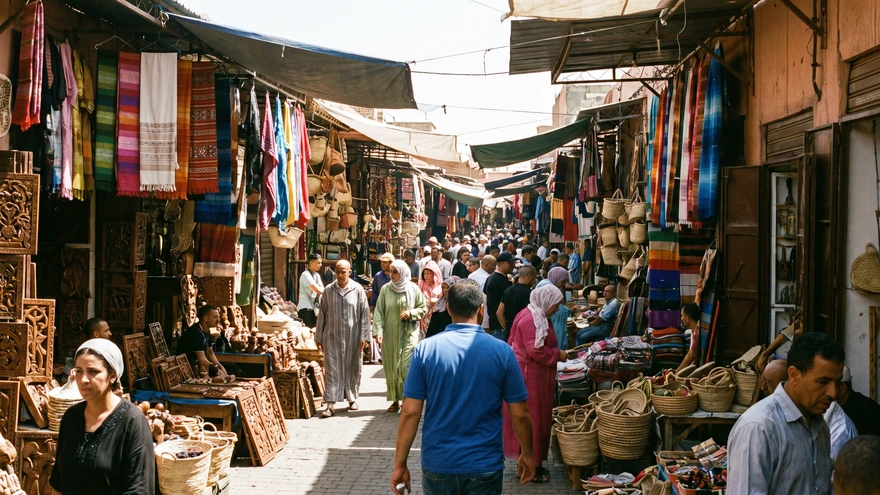
Sucupira Market, down in the valley between the Plateau and the Fazenda district, is the largest open-air market on the island. It's a dense, sprawling maze where you can buy almost anything: traditional textiles, West African wood carvings, wicker baskets, electronics, and local street food.
Sucupira is also the city's primary transport hub, which makes it incredibly crowded. It isn't violently unsafe, but it's the prime spot for petty pickpocketing, so keep your phone in a front pocket, skip the visible jewelry, and avoid carrying large amounts of cash. Go early, around 8:30 AM, when the activity is peaking but the afternoon heat hasn't set in yet.
Dona Maria Pia Lighthouse and Prainha Beach
To escape the concrete rush of the city center, head two kilometers south to the upscale neighborhood of Prainha, home to most international embassies and boutique hotels. If you'd rather lock in a place to stay before you land, this is the neighborhood to Search hotels in Praia closest to the water.
Follow the coastal road down to the Dona Maria Pia Lighthouse (Farol de Dona Maria Pia), built in 1881 on a rocky peninsula guarding the entrance to the port. You can't go inside the structure itself, but the surrounding cliffs offer the best sunset views in Praia, completely free from building obstructions.

After the lighthouse, walk back toward Prainha Beach. Unlike Gamboa Beach, which is scenic but generally not recommended for swimming because of water quality near the port, Prainha is a small, protected sandy cove with crystal-clear water. It's popular with locals for late-afternoon swims and beachfront workouts.
Is Praia Safe? Real-World Safety Parameters
Internet forums often paint an exaggerated picture of crime in Praia, while glossy travel guides tend to ignore the subject completely. The reality sits somewhere in between, and it mirrors the broader safety patterns across Cabo Verde: low compared to mainland West Africa, but not zero-risk.
During the day, Praia is perfectly fine to explore on foot. Standard urban precautions apply: watch your bags in crowded areas like the markets and main shopping streets.
After dark, don't walk between neighborhoods. The valleys, stairwells, and connecting roads between the Plateau, Achada Santo Antonio, and Prainha are unlit and prone to opportunistic robberies. Even if a destination looks like a 10-minute walk away, call a taxi instead.
Avoid entering the Fazenda and Fonton neighborhoods after dark unless you're with a trusted local guide.
Getting Around: Taxis and Alugueres
Understanding how to get around will save you both time and money.
City taxis in Praia are cream-colored with a blue stripe. They don't run meters, so agree on the price before you get in. A standard ride within the city limits during the day costs 200 to 300 CVE; if a driver quotes more than 400 CVE for an internal city trip in daylight, they're overcharging you.
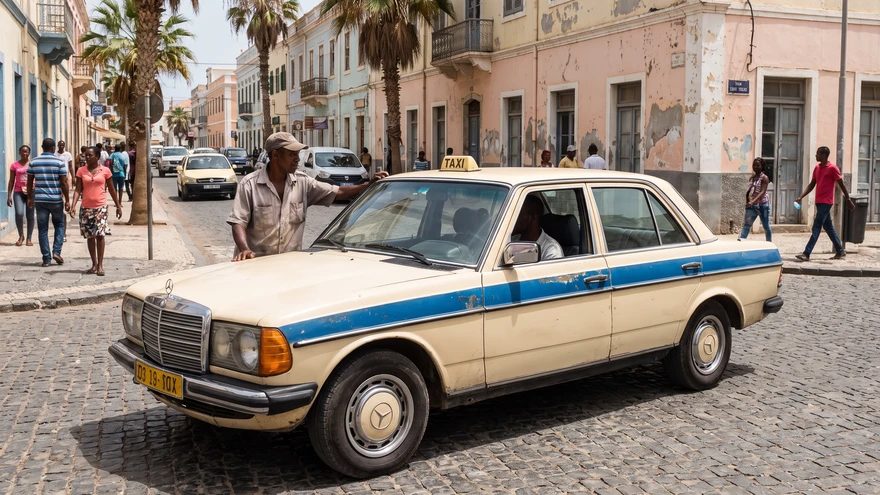
Alugueres, shared Toyota Hiace minibuses, are the lifeblood of Cape Verdean transit. They don't run on fixed timetables; they leave once they're completely full.
For a day trip to Cidade Velha, the UNESCO-listed old capital 15 kilometers away, head to the staging area next to the fire station (Bombeiros) at the edge of the Plateau and Sucupira border. The ride costs roughly 150 CVE each way. If you'd rather skip the logistics entirely, you can Book a guided Cidade Velha day trip instead of hunting down the right minibus yourself.
For the longer run north to Tarrafal, alugueres depart from a terminal near the Sucupira and Fazenda border. Expect a rough, scenic two-hour ride for around 500 CVE. Once there, the Tarrafal concentration camp is one of the most sobering historical sites in the country.
Where to Eat: Authentic Cachupa and Live Creole Music
Cape Verdean cuisine blends Portuguese maritime traditions with West African flavors, leaning heavily on fresh seafood and corn. For a wider look at the archipelago's dishes, see our guide to Cape Verde food and drink.
The national dish is Cachupa, a slow-cooked stew of corn, beans, cassava, and sweet potato. It comes in two forms: Cachupa Rica, made with pork, sausage, or fish, and Cachupa Refogada, the leftover stew fried the next morning and usually topped with a fried egg.
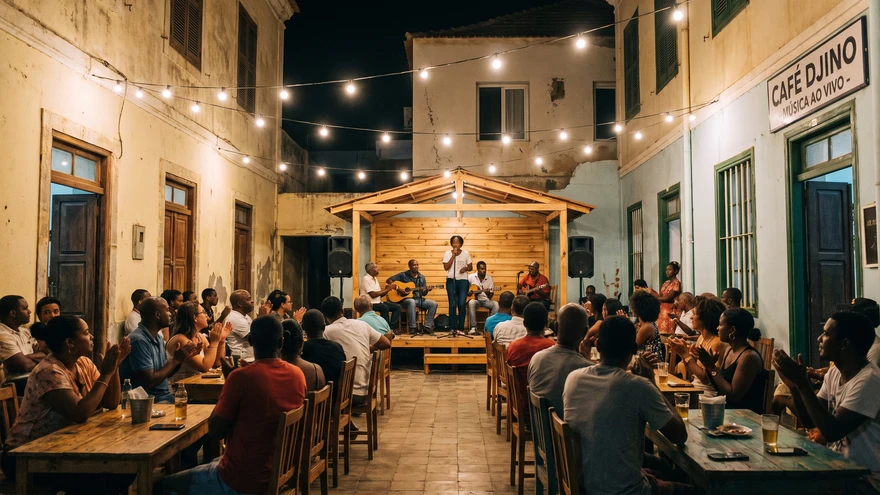
Quintal da Musica, on the Plateau, is a mandatory cultural stop that pairs excellent traditional food with live Morna and Funana performances. Book a table at least a day ahead, since it fills up with tourists and locals alike every night.
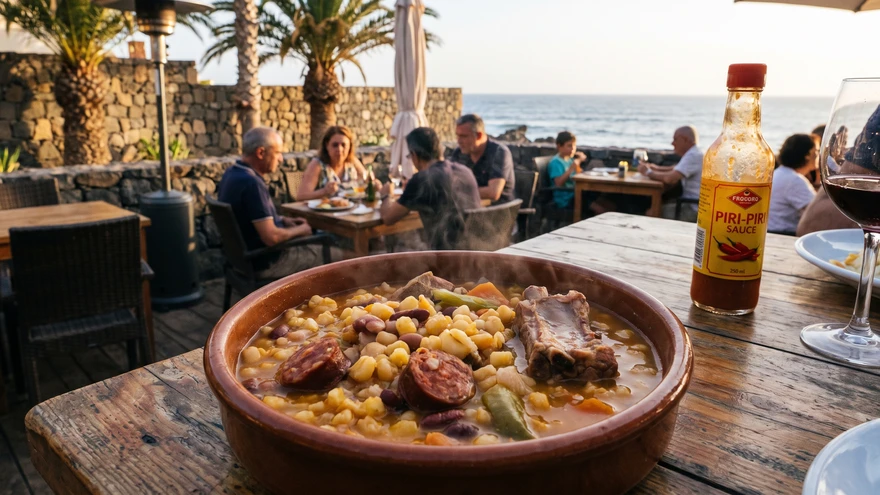
Kebra Cabana, on Quebra Canela Beach further south, is a casual, open-air spot for fresh grilled grouper, octopus, and a cold Strela, the local Cape Verdean beer. Finish the meal with a glass of Grogue, a potent local rum distilled from sugarcane, or a glass of red wine from the volcanic soil of Fogo Island.