The Marshall Islands played a decisive role in the Pacific Theater of World War II - a role that is still visible today across Kwajalein Atoll and in the collections of the Alele Museum in Majuro.
Comprising 29 coral atolls and over 1,200 islands and islets, this remote Pacific archipelago became the strategic linchpin of America's island-hopping campaign, the site of one of the war's most brilliantly executed amphibious operations, and the graveyard of Japan's outer Pacific defensive perimeter.
| Dates | January 31 - February 7, 1944 |
| Location | Kwajalein Atoll, Roi-Namur, Majuro |
| US Commander | Admiral Chester W. Nimitz, Rear Admiral Richmond K. Turner, Major General Holland Smith |
| Japanese Commander | Rear Admiral Monzo Akiyama |
| US Forces | ~85,000 troops (5th Amphibious Corps) |
| Japanese Forces | ~8,000 garrisoned troops |
| Outcome | Decisive US victory; forward naval and air bases established |
The Strategic Value of the Marshall Islands
To understand the ferocity of the Pacific War, you have to look at the geography of the Marshall Islands. Situated roughly halfway between Hawaii and the Philippines, the archipelago divides into two parallel chains: the Ratak (Sunrise) chain to the east and the Ralik (Sunset) chain to the west.
During the early 1940s, these atolls represented an unsinkable line of aircraft carriers for the Japanese military. By establishing airfields and seaplane bases across the islands, Japan could effectively monitor, intercept, and threaten American shipping lanes stretching between the United States, Hawaii, and Australia.
For the United States Pacific Fleet, commanded by Admiral Chester W. Nimitz, the Marshalls were a mandatory stepping stone. Without neutralizing or capturing them, any westward advance toward the Marianas, the Philippines, or the Japanese home islands would leave American flanks dangerously exposed to land-based air attacks.
Japanese Occupation and Militarization (1914-1944)
The Japanese presence in the Marshall Islands did not begin with World War II. It was a legacy of World War I.
The League of Nations Mandate
In 1914, at the outbreak of the First World War, Japanese naval forces seized the Marshall, Caroline, and Mariana islands from the German Empire. Following the Treaty of Versailles, the League of Nations formally granted Japan a Class C Mandate over these territories, known collectively as the "Japanese Mandated Islands." Under the terms of the mandate, Japan was technically forbidden to militarize the islands or build fortifications.
Fortifying the Outer Perimeter
The geopolitical landscape shifted dramatically in 1933 when Japan withdrew from the League of Nations. Free from international oversight, the Imperial Japanese Navy (IJN) began transforming the tranquil lagoons into heavily fortified military bastions. Non-Japanese citizens, including Western missionaries, were systematically barred from the region.
The Japanese built sophisticated military infrastructure across key atolls:
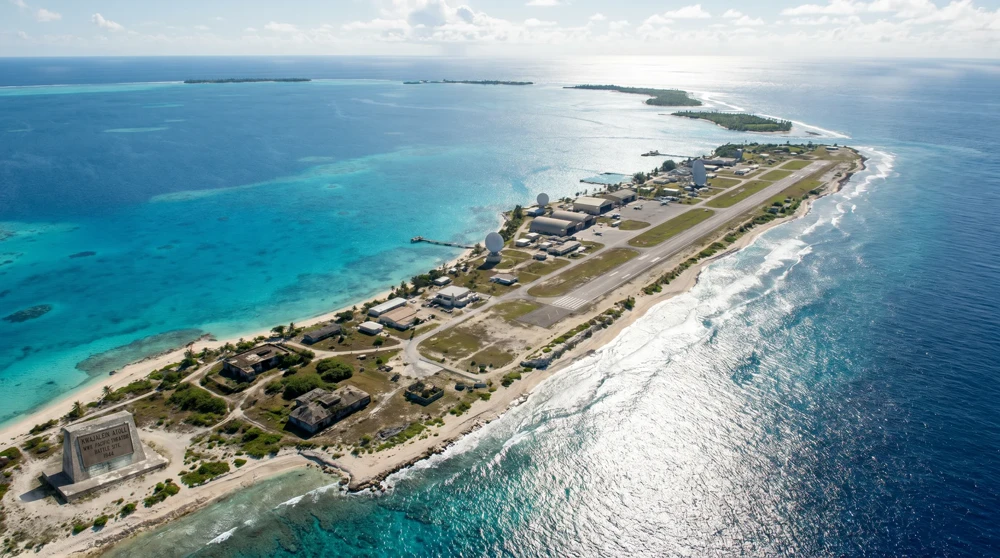
- Kwajalein Atoll: Developed into the administrative and logistical headquarters, featuring a massive airfield on Kwajalein Island and another on the twin islands of Roi-Namur.
- Wotje and Maloelap: Fortified with heavy coastal defense artillery, anti-aircraft batteries, and fighter airstrips.
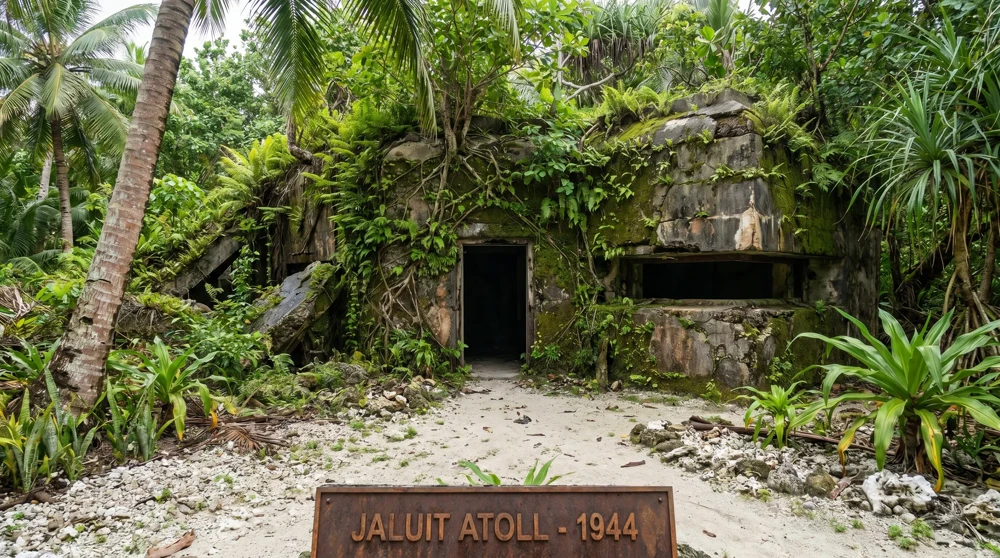
- Jaluit: Utilized primarily as a major seaplane base and torpedo-boat station.
By 1941, these islands formed a formidable defensive shield designed to absorb the shock of any American offensive pushing westward across the Pacific.
The Island-Hopping Strategy: Why the Marshalls?
Following the bloody and costly capture of Tarawa in the Gilbert Islands in November 1943, American planners faced a critical choice. Traditional military doctrine dictated attacking the outer crust of enemy defenses first. In the case of the Marshalls, this meant hitting the heavily fortified outer atolls of Wotje, Maloelap, and Mili.
However, Admiral Nimitz made a brilliant and highly controversial strategic pivot. Rather than wasting American lives on the heavily fortified outer rim, US forces would utilize the island-hopping (or leapfrogging) strategy. The plan was to completely bypass Wotje and Maloelap, leaving their garrisons to wither on the vine, cut off from supply lines. Instead, US forces would strike directly at the heart of the archipelago: Kwajalein Atoll.
This move caught the Japanese completely off guard. Imperial planners had assumed the Americans would attack the outer islands first, and consequently concentrated their best troops and heaviest fortifications there, leaving Kwajalein relatively under-defended.
Operation Flintlock: The Assault on Kwajalein and Roi-Namur
Launched on January 31, 1944, Operation Flintlock was the amphibious assault aimed at capturing Kwajalein Atoll. It remains one of the most successfully executed amphibious operations of World War II, largely due to the painful lessons learned just months earlier at Tarawa.
Crucial Lessons Learned from Tarawa
The assault on Tarawa had been a near-disaster due to inadequate naval bombardment, a lack of tracked landing vehicles, and poor coordination. For Operation Flintlock, the US military radically altered its tactics:
- Massive Pre-Landing Bombardment: Instead of a brief, hours-long bombardment, American battleships, cruisers, and airstrikes pounded Kwajalein for three consecutive days. The sheer volume of explosives leveled almost all surface structures and severely dazed the defenders.
- Deployment of LVTs (Landing Vehicle Tracked): To avoid troops getting stuck on coral reefs, hundreds of specialized amphibious tractors (Alligators and Buffaloes) were deployed to carry infantry directly from the sea onto the beaches.
- Artillery Placement on Adjacent Islets: Before hitting the main targets, US troops captured small, undefended islets next to Kwajalein and Roi-Namur. Artillery batteries set up on these islets provided continuous, close-range fire support during the primary landings.
Amphibious Landings and Tactical Execution
The operation split into two main thrusts.
In the north, the 4th Marine Division assaulted the conjoined islands of Roi-Namur. The Marines encountered fierce but disorganized resistance. On Namur, a cataclysmic explosion occurred when a Marine threw a satchel charge into a bunker that turned out to be a Japanese magazine storage facility, killing over 20 Marines and wounding scores more. Despite this setback, Roi-Namur was secured within 24 hours.
In the south, the US Army's 7th Infantry Division landed on Kwajalein Island. The fighting was a methodical, bloody clearance operation. The Japanese garrison, commanded by Rear Admiral Monzo Akiyama, fought from a network of reinforced concrete pillboxes, trenches, and underground bunkers. Because surrender was against the Imperial military code (Bushido), nearly the entire garrison fought to the death. Kwajalein Island was declared secure on February 4, 1944.
Operation Catchpole: The Fall of Enewetak
With Kwajalein captured ahead of schedule and with lower-than-expected casualties, Admiral Nimitz immediately exploited the momentum. On February 17, 1944, the US launched Operation Catchpole, the amphibious assault on Enewetak Atoll, located several hundred miles northwest of Kwajalein.
Enewetak was critical because it possessed a large airfield and a deep lagoon capable of anchoring entire naval fleets. The assault was carried out by the 22nd Marine Regiment and the Army's 106th Infantry Regiment. The defenders put up vicious resistance, utilizing camouflaged spider holes and subterranean tunnels. Faced with overwhelming fire support from the US Navy, the island fell by February 21, 1944.
The Aftermath and Shift in the Pacific War
Operation Flintlock and the subsequent capture of Enewetak marked a profound turning point in the Pacific War. The myth of the invincible Japanese island fortress was permanently shattered.
By bypassing the outer atolls like Wotje and Jaluit, the US effectively neutralized tens of thousands of Japanese troops without firing a single shot on those islands. These bypassed garrisons were left completely isolated, suffering from starvation and disease until the end of the war in 1945.
Strategically, the Marshall Islands provided the United States Pacific Fleet with vital forward bases. Kwajalein lagoon became the world's largest advance naval base, allowing the US to supply and launch the next critical phase of the war: the invasion of the Mariana Islands (Saipan, Tinian, and Guam) in the summer of 1944. The path to the Japanese homeland was now wide open.
Visiting the Marshall Islands Today: Traces of the War
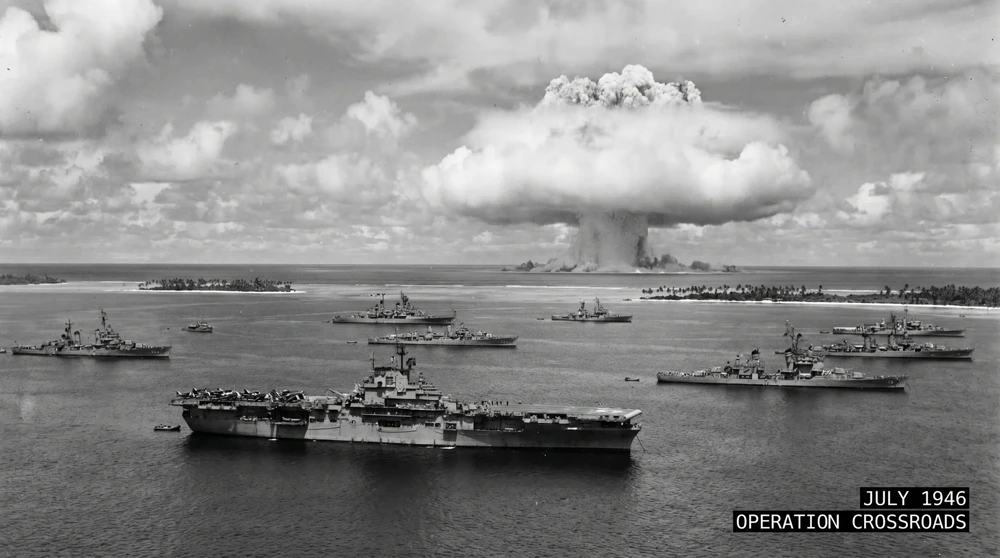
For travelers with an interest in military history, the Marshall Islands offer a surprisingly accessible window into the Pacific War. The lagoons around Kwajalein and Jaluit still contain sunken Japanese vessels, while coastal gun emplacements and concrete bunkers survive on several outer atolls. Technical divers can access the most remarkable of these wrecks through Bikini Atoll expeditions - our diving Bikini Atoll guide covers the nuclear ghost fleet, technical requirements, and the full logistics of reaching this UNESCO site.
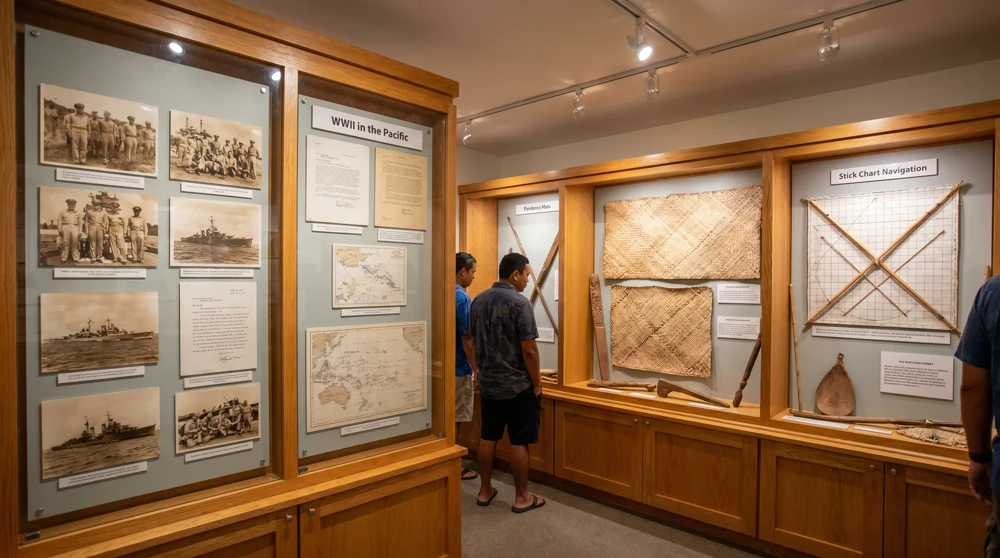
In Majuro, the Alele Museum houses one of the Pacific's most important collections of Marshallese cultural artifacts alongside documents and photographs from the Japanese occupation and wartime period. For those planning a visit, our Marshall Islands for country collectors guide covers the practical logistics of getting to Majuro, accommodation, and what to expect on the ground. If you are planning a visit to explore this history firsthand, Travel insurance that covers remote Pacific destinations is worth arranging before you fly.
The war left a permanent imprint on the Marshallese people, their geography, and their relationship with foreign powers - a legacy that continued well beyond 1945 with the nuclear testing era at Bikini Atoll and Enewetak - covered in full in our Marshall Islands nuclear legacy guide.