Most visitors waste hours driving across Malta trying to see every single stone tower, only to find locked doors, overgrown paths, and zero parking. Focusing your route strictly on the accessible, inter-visible chain of the Knights' coastal defences gives you a seamless historical dive without the logistical headache.
The Red Tower (St. Agatha's Tower) in Mellieħa is the natural anchor for a day out, fully restored and offering the best panoramic views on the island. Many smaller outposts cost nothing to explore from the outside, while the handful run by heritage NGOs ask only a small donation of around two to three euros. Most interiors keep short morning hours that depend heavily on volunteer availability, so weekend schedules are worth a quick local check before you set off.
The Strategy Behind the Inter-Visible Defence Chain
The Maltese coastline was practically unprotected until the early 1600s. The Knights of St John quickly realised that isolated, inland fortresses were useless against sudden corsair raids, so they engineered a brilliant early warning system right on the water's edge.
Each tower sits in direct line of sight with its neighbours. A fire lit by the local militia at a Gozo outpost triggered a visual chain reaction across the Comino channel, bouncing down the Maltese coast and reaching the Grand Harbour in a matter of minutes.
This network evolved through three distinct architectural phases under Grand Masters Wignacourt, Lascaris, and De Redin. The earlier structures were massive, heavily armed fortresses designed to fight. Later designs shrank into purely observational watchposts, acting strictly as the eyes and ears of the island. If you want the wider story of the men behind these walls, the Knights of Malta and their key sites put this defensive obsession in full context.
Exploring the Flagship: The Red Tower (St. Agatha's Tower)
If you only have time to climb one coastal fortification, make it this one. The striking crimson walls of St. Agatha's Tower command the crest of Marfa Ridge, completely dominating the northern skyline.
Built in 1649, the structure retains its distinctive fish-tail crenellations and four square corner turrets. The interior features a massive barrel-vaulted roof, originally engineered to absorb the recoil of heavy artillery firing at enemy ships.
Climbing to the roof terrace is non-negotiable. The panoramic sweep covers Mellieħa Bay, the Comino channel, and the rugged Gozo shoreline, perfectly illustrating the inter-visible communication concept. It also doubles as one of the finest vantage points on the island, and the wider list of the best sunset spots in Malta leans on exactly this kind of high coastal ground.
Din l-Art Ħelwa, the national heritage trust, has managed the site since 1998. The tower generally opens Monday to Saturday and stays closed on Sundays, with morning-to-late-afternoon hours that shorten in winter. Your small entry donation supports ongoing restoration, including the wooden floor fitted with glass panels that expose the original, uneven stone slabs below.

Key Watchtowers and Batteries Along the Coast
Tracing the coastline reveals a strategic mix of imposing, multi-story fortresses and subtle, low-profile artillery platforms. Knowing which ones actually open their doors saves you a wasted detour.
- Wignacourt Tower (St Paul's Bay): The oldest surviving coastal tower, dating to 1610, now a free-to-modest-donation museum with fortification models and a restored cannon. Open mornings, Monday to Saturday, depending on volunteers.
- The White Tower (L-Aħrax): A 1658 De Redin tower above Armier Bay, reopened to visitors in 2021 after a full restoration, so this is one of the few small outposts you can actually step inside.
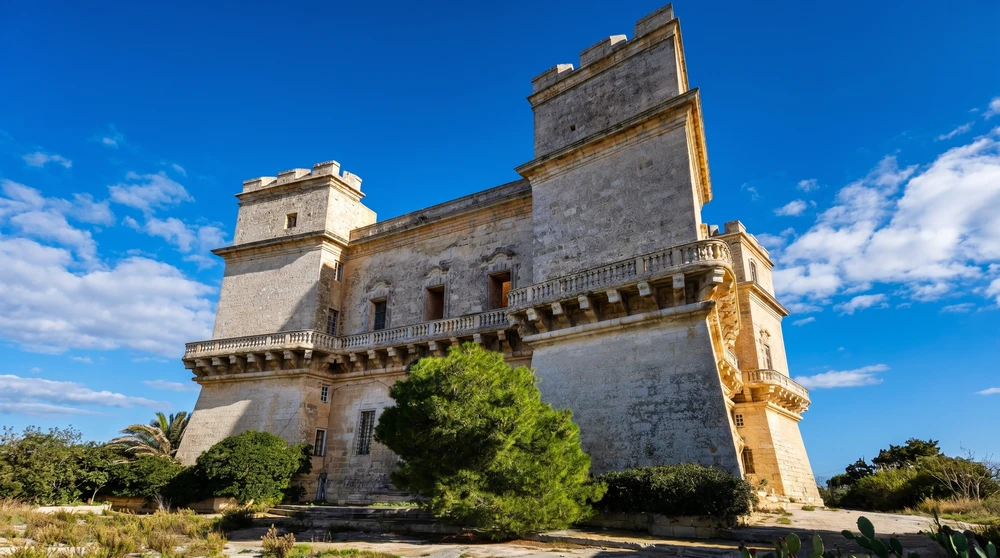
- Selmun Tower: A fortified villa rather than a pure watchpost, with grand facades and unpaved trails leading down toward Mistra Bay.
- Ħamrija Tower (Għar Lapsi): The dramatic clifftop link near Għar Lapsi, restored by Heritage Malta, with vertical drops into deep blue water and the islet of Filfla on the horizon.
- Mistra Battery: A low, semi-circular gun platform sitting almost flush with the shoreline, a textbook example of the 18th-century shift from tall towers to coastal batteries.
- Santa Marija Battery (Comino): An early 18th-century battery facing the South Comino Channel, with original iron cannons still in place and a small museum inside.
Wignacourt Tower at St Paul's Bay
This is the oldest surviving coastal tower, dating back to 1610. It stands directly over the bay, originally mounting heavy cannons to dominate the sheltered anchorage. Since 1998 the ground floor has worked as a small museum, displaying scale models of Maltese fortifications, period reproductions, and a restored cannon. The heavy stone walls are incredibly thick, keeping the interior noticeably cool even at the peak of the Mediterranean summer.
The White Tower (Torri l-Abjad)
Positioned on the harsh L-Aħrax peninsula, this 1658 De Redin tower protected the extreme northern tip of Malta. Records show it cost exactly 589 scudi to construct, a hefty sum for its time. After three years of restoration it reopened to the public in 2021, so you can now see the interior rather than just circle the walls.
The surrounding terrain is rocky and wild. A small artillery battery sits just below the tower, added in the early 18th century to boost the site's firepower against shallow-draft corsair vessels attempting to land in the coves.

Selmun Tower
Though often mistaken for a purely military structure due to its robust, fort-like appearance, Selmun was actually designed as a fortified villa. The facade is grand, providing a stark contrast to the strictly utilitarian watchposts along the cliff edges. The surrounding grounds offer excellent, unpaved walking trails leading directly down to Mistra Bay.
Ħamrija Tower at Għar Lapsi
Guarding the dramatic southwestern cliffs near Għar Lapsi, this structure represents one of the final links in the De Redin chain. The view drops vertically into deep blue water, with the uninhabited islet of Filfla resting on the horizon. The nearby Mnajdra and Ħaġar Qim temples make this a highly efficient dual-itinerary stop.
Mistra Battery
Coastal batteries largely replaced the tall towers in the 1700s as naval artillery warfare advanced. Mistra Battery is a prime example of this low-profile, deadly coastal defence. The semi-circular gun platform sits almost flush with the shoreline. Its tactical design let defenders sweep the water surface with devastating cannon fire while remaining practically invisible from the open sea.
Santa Marija Battery on Comino
Do not confuse this with the towering St. Mary's Tower dominating the island's centre. The battery lies further along the harsh Comino coast, built directly facing the South Comino Channel. The original iron cannons remain in place, pointing silently toward the Maltese mainland.
Reaching the battery means a roughly 40-minute walk from the Blue Lagoon over exposed terrain, which effectively filters out the heavy tourist crowds. One change worth flagging: anyone setting foot on Comino now needs a free pre-booked access ticket, since the island is a protected Natura 2000 site. The same crossing logic that gets you to the Blue Lagoon on Comino gets you to the battery, you just keep walking past the swimmers.
How to Get to the Coastal Defences
Relying entirely on public transport to trace this route requires endless patience. Bus stops are often kilometres away from the actual cliff edges, leaving you exposed to the harsh sun or coastal winds.
A car or scooter gives you the freedom to hop between the northern towers, especially along the Marfa Ridge and the L-Aħrax point, and parking is generally free and unstructured on the dirt patches near the more remote sites. If you have not sorted wheels yet, renting a car in Malta covers the local driving quirks and insurance traps worth knowing before you take on these gravel approaches.
Always wear sturdy footwear. The final approaches to places like the White Tower or Mistra Battery involve loose gravel, uneven limestone surfaces, and steep coastal paths. The reward for that minor effort is a chain of fortifications most package tourists never see, strung along some of the most photogenic coastline on the island.