If you are planning a trip to Valletta and want the most immersive slice of Malta's wartime history, the Lascaris War Rooms belong near the top of your itinerary. Tucked deep within the limestone foundations of the capital, this underground network of tunnels and operations rooms served as the nerve centre for Britain's Mediterranean defence during World War II.
You will descend roughly 120 feet (40 meters) beneath the Upper Barrakka Gardens to reach rooms that look almost exactly as they did at the height of the conflict. The sections below walk you through finding the famously hidden entrance, choosing the right ticket, and understanding the history beneath your feet.
Hours, Location, and Payment
The complex opens Monday to Saturday, 10:00 to 16:30, with the last admission at 16:00. It stays closed on Sundays and major holidays, including New Year's, Good Friday, Easter, and Christmas, so a weekday morning is the safest slot to plan around.
The entrance sits in the Lascaris Ditch, deep beneath the Upper Barrakka Gardens in Valletta. On-site ticket purchases are card-only, since the venue runs entirely cash-free, so bring a card or book ahead.
How to Find the Hidden Entrance via Lascaris Ditch
One of the most common complaints from travelers is how difficult the rooms are to find. The secrecy was intentional during WWII to shield the complex from German and Italian aerial bombardment, but today it just means a bit of navigational know-how. There are two main routes down into the Lascaris Ditch.
- Upper Barrakka / Battery Street route: From the Upper Barrakka Gardens or the adjacent Saluting Battery, walk east down Battery Street, follow the museum signs, and prepare for several flights of steep stone steps into the ditch. At the bottom, walk through the eastern end of the Lascaris Tunnel to reach the main entrance.
- Castille Place bridge route: Coming from the Valletta Central Bus Station, head toward the roundabout behind the war memorial and up Triq Girolamo Cassar toward Castille Place. Before crossing the large road bridge over the ditch, find the ramp and metal staircase on the western side, take them all the way down, and walk eastward underneath the bridge.
Because the site is carved into the bedrock and involves dozens of steps, it is not wheelchair accessible and can be challenging for anyone with limited mobility.
Ticket Prices and Heritage Pass Options
Booking online in advance is the smoothest approach and helps you skip any queue at the desk. Standard admission is €20 for adults aged 16 and over, €19 for seniors aged 60 and over with valid ID, and €7 for children aged 5 to 15. A €35 family ticket covers two adults and three children under 16, and members enter free.
If you plan to explore more of Malta's military heritage, the Wirt Artna Heritage Pass is worth a serious look. It is valid for one consecutive week from first use and delivers roughly a 40% saving against buying individual tickets. The individual pass costs €50 and the family version €95.
The pass grants one-time access to the Lascaris War Rooms, Saluting Battery, War H.Q. Tunnels, Malta Time Gun Museum, Malta at War Museum in Birgu, Fort Rinella, St. Peter's Galleries, and St. Thomas Tower.
If a single Valletta attraction is all you have time for, the standalone ticket makes more sense, but anyone touring the bastions over a few days recovers the pass cost quickly. The Heritage Malta Pass and Malta Discount Card cover different attractions, so it pays to check which sites each one unlocks before you buy.
Inside the War Rooms: What You Will See
Step past the threshold into the cool underground air and you immediately notice an authentic period atmosphere. Painstakingly restored by the Fondazzjoni Wirt Artna heritage foundation since 2009, the rooms look much as they did during the height of the conflict.
The Allied Command Centre and Operation Husky
The historical weight of this complex is hard to overstate. In 1943, these chambers became the advanced Allied Headquarters for Operation Husky, the pivotal invasion of Sicily. As you walk through the plotting rooms, you stand exactly where US General Dwight D. Eisenhower, British Field Marshal Bernard Montgomery, and Admiral Andrew Cunningham coordinated the invasion strategy.
One of the primary highlights is a massive, authentic map of Sicily mounted directly to the wall, used to track troop movements and shifting frontlines across the Mediterranean.
The Filter Room and Typex Machines
The defensive operations spread across three large operations rooms and several galleries. In the central RAF Fighter Control Room, you will see the historic map tables and tote boards where radar traffic was channeled. Historical photos reveal that it was predominantly women of the service who worked the maps and indicators on the floor, while men supervised from the glass-paneled galleries above.
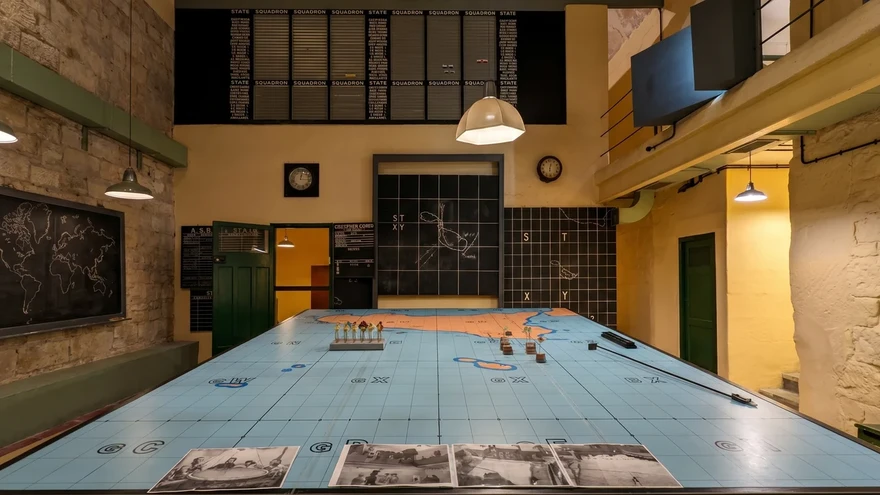
The side rooms and cabinets are densely packed with period switchboards, original sector clocks, friend-or-foe aircraft identification charts, and remarkably rare Typex encryption machines. These British cipher devices handled ultra-secret communications, keeping Allied tactical decisions hidden from Axis intelligence.
Cold War Era: The NATO Expansion
The strategic value of the Lascaris complex did not end in 1945. After WWII, the Royal Navy handed the site to NATO, and through the height of the Cold War, until 1977, the secret tunnels served as a strategic submarine tracking station. Operators worked around the clock here to monitor Soviet submarines moving through the Mediterranean. If the underground military theme draws you in, the WWII shelters and Fort St Elmo tell the wider story of how the island survived the siege from the air.
Guided Tours vs Self-Guided Visits
Your standard admission ticket lets you choose how to experience the museum. If you prefer your own pace, audio guides are available at the desk in roughly a dozen languages, and you can watch historical film screenings inside the complex, including the 1942 documentary "Malta G.C." and "A Convoy to Malta".
For military buffs who want the finer details, guided tours led by experts in period uniforms run throughout the day and are included in your standard admission fee, so there is no reason to skip them.
The Exclusive War H.Q. Tunnel Tour
For an even deeper dive, you can buy a separate ticket for the exclusive War H.Q. Tunnel Tour. These excursions run twice daily at 10:30 and 13:00, starting from the Saluting Battery, and guide you through the interconnected tunnels that once joined the various service commands. Tickets are €17 for adults and €7 for children. Note that this tunnel tour is not covered by the multi-site Heritage Pass and must be booked independently.
Combining Your Visit with the Saluting Battery
Because of their physical proximity, the best way to structure your day is to pair the Lascaris War Rooms with the Saluting Battery, which sits directly above the complex on the Valletta bastions. The battery is famous for its historic noon gun firing.
If you time it well, you can explore the underground depths in the morning, climb up to the bastions to watch the artillery ceremony and the panoramic views of the Grand Harbour at 12:00 PM, then stop for a snack or coffee at the Victory Cafe inside the museum shop area.
Travelers piecing together a wider day can fold this stop into a broader Valletta itinerary, since the war rooms, cathedral, and harbour viewpoints all sit within a short walk. Cruise passengers on a tight clock can still manage it as part of a focused 6-hour Valletta plan, as long as you start early and book the underground slot ahead.