Relying on outdated travel brochures or old restoration notices will trip you up here, because Fort Rinella now opens Monday to Saturday from 10:00 to 16:30, not just on weekends as many forums still claim. Timing your visit to catch the 14:00 guided tour unlocks the headline event, a full historical re-enactment that ends with live artillery and the world's largest muzzle-loading cannon looming over you. This is a working garrison brought back to life by volunteers, not a glass-case museum, and the difference is obvious within minutes of walking through the gate.
What Makes Fort Rinella Worth Visiting?
Unlike the static military museums scattered across the island, this 19th-century coastal battery runs as a living time capsule. Re-enactors in authentic Victorian uniforms move around the grounds throughout the day, drilling with bayonets, running signalling exercises and putting on cavalry routines. You get an unfiltered look at the harsh daily grind of a British soldier posted to the Mediterranean, rather than a plaque telling you about it.
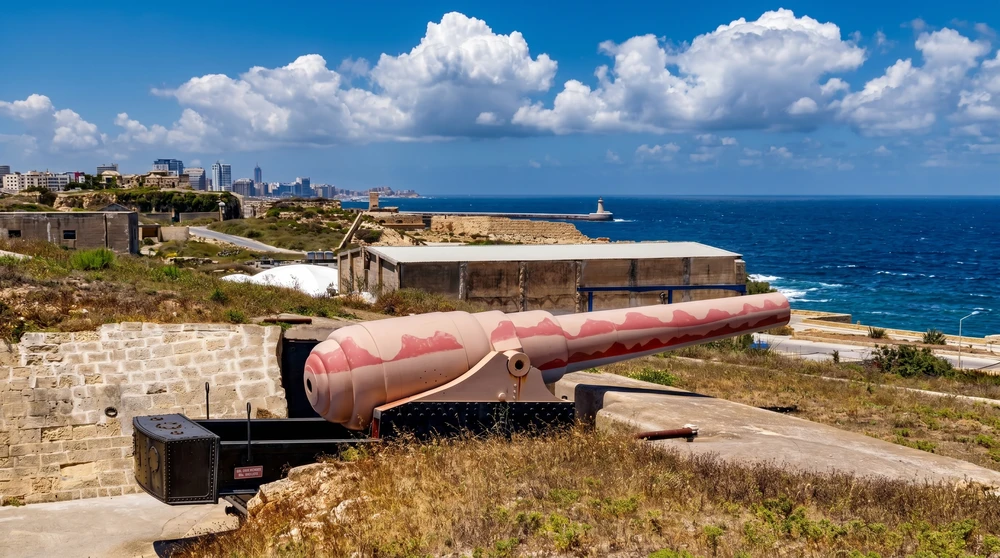
The undisputed centrepiece is the Armstrong 100-ton gun. Capable of firing a one-ton shell over a distance of roughly three miles, this mechanical monster needed a steam-driven hydraulic system just to load and traverse. Exploring the subterranean engine rooms and loading chambers underneath it gives you a real sense of how far Victorian engineers were willing to push the technology of the day.
When Is Fort Rinella Open and What Are the Show Times?
The fort runs Monday to Saturday, 10:00 to 16:30, with last admission at 16:00. It closes on a handful of public holidays, including New Year's Eve and Day, Good Friday, Easter and Christmas, so check the date if your trip lands near one of those.
The day is built around scheduled displays, and arriving early lets you fit the underground tour in before they start. The standard rhythm runs like this:
- 12:00: Military signalling display
- 13:00: Swordsmanship display
- 14:00: Main guided tour with full historical re-enactment, artillery firing and the cavalry show
The 14:00 slot is the one to plan around, since it bundles the re-enactment, the cannon demonstration and the cavalry into a single block. Allow two and a half to three hours on site to cover the demonstrations and still have time underground.
Living History Shows and the Martini-Henry Experience
The value of your ticket leans heavily on the guided tours, and the staff are the reason. Guides are regularly singled out by visitors for pairing genuine historical depth with sharp, dry humour. They walk you through the labyrinth of defensible barracks, caponiers and lift-shafts, explaining how a crew of just seven men could operate the enormous artillery above their heads.
Firing a 19th-Century Rifle
The highlight for most visitors comes at the end of the weapons demonstration. For a small €5 donation toward the restoration fund, you step onto the firing line yourself.
Under strict supervision, you load and fire a blank cartridge from an original Martini-Henry Mk II, the exact .45 inch breech-loading rifle the British Army carried during the Zulu Wars. It is loud, visceral and genuinely photogenic, and even children around eight are usually allowed to take a turn. Note that the 100-ton gun itself is non-operational and never fired a shot in anger, so the live firing is limited to rifles and smaller blank-firing pieces.
How to Get to Fort Rinella from Valletta
Public transport is the most straightforward way to reach Kalkara, and bus number 3 is the one you want. It departs regularly from the main Valletta terminal and stops right outside the fort's main gate, with the ride taking around 40 minutes depending on coastal traffic. If you are weighing up routes across the island, getting around Malta on public transport is cheap and reliable once you understand the network.
There is a more scenic alternative. Skip the long bus ride out of the capital and take the ferry from Valletta across the Grand Harbour to Cospicua (Bormla), one of the Three Cities across the harbour. The views of the fortified bastions from the water are superb, and the crossing costs the same as a standard bus ticket. Once you dock, head to the nearest stop and catch the same number 3 bus for a quick five-minute final stretch to the fort.
A Brief History of the Fort
The British military built Fort Rinella between 1878 and 1886 in direct response to a naval threat. Italy had just launched the Duilio-class battleships, heavily armoured vessels carrying 22 inches of steel protection and their own massive guns. Fearing the loss of naval supremacy and control over the vital Suez Canal route to India, the British commissioned four 100-ton guns, placing two in Gibraltar and two in Malta.
The gun mounted at Kalkara arrived in 1882 and took 100 men three months just to drag from the docks to its current position. The cannon never fired in combat, and rapid advances in military technology rendered it obsolete by 1906, barely twenty years after the fort was finished. Today, the volunteers of Fondazzjoni Wirt Artna spend their time restoring the site and coaxing the complex hydraulic mechanisms back to life, which is exactly why the live demonstrations feel so different from a roped-off exhibit. If you enjoy this era of Maltese defence, the island's older bastions at Fort St. Elmo and its wartime shelters make a natural follow-up.