Finding the actual entrance to the Tarxien Temples can be slightly confusing if you arrive from the main street, and buying tickets at the door sometimes feels rushed because of the automated machines. Booking online or arriving early saves you the awkward shuffle at the entrance and gives you more time to explore these 5,000-year-old megaliths without the stress. This guide covers tickets, opening hours, transport, and what actually makes the site worth your time.
- Adult admission: €6.00
- Youth (12-17), students, and seniors (60+): €4.50
- Children (6-11): €3.00
- Infants under 5: free
- Opening hours: 9:00 to 17:00, with last admission at 16:30
- Time needed: 30 to 45 minutes
- Closed on 24, 25, and 31 December, 1 January, and Good Friday
The whole complex is fully wheelchair and stroller accessible thanks to raised wooden walkways, which is unusual for a prehistoric site. It sits on Neolithic Temples Street in Tarxien, just a short walk from the Hal Saflieni Hypogeum.
If you plan to see more than one prehistoric site, the Heritage Malta Prehistoric Combo ticket costs €16.00 for adults and covers Tarxien, Hagar Qim and Mnajdra, Ghar Dalam, and Borg in-Nadur. It is valid for 30 days from first use, so you do not have to cram everything into one day.
What Makes Tarxien Temples Unique
Instead of standing alone in the rugged countryside like other Maltese ruins, this UNESCO World Heritage site sits right in the middle of a modern residential neighborhood. The contrast between ancient history and everyday town life is striking. Built between 3600 and 2500 BC, the complex represents the peak of prehistoric temple building on the island. It features a six-apse layout you will not find anywhere else in Malta.
The Megalithic Art and the Fat Lady Statue
Tarxien is famous for its intricate stone carvings. As you walk through the ruins, look for the detailed reliefs of domestic animals such as goats, bulls, pigs, and rams. These carvings offer a rare glimpse into the daily life, diet, and ritual practices of the early islanders.
The most iconic artifact here is the colossal statue known as the Fat Lady. Only the lower half, wearing a pleated skirt, survives today. It likely represented a fertility goddess and gives a real sense of scale to the religious practices of the Neolithic period.
Original Artifacts vs. Replicas
The decorated stone blocks and the Fat Lady statue you see on site are actually high-quality replicas. To protect the soft globigerina limestone from deterioration, the original artifacts were carefully moved indoors during the 1950s.
If you want to see the authentic 5,000-year-old stones, make a quick stop at the National Museum of Archaeology in Valletta before or after your visit. Seeing the originals first completely changes how you read the layout of the actual site.
Accessibility, Pathways, and the Protective Canopy
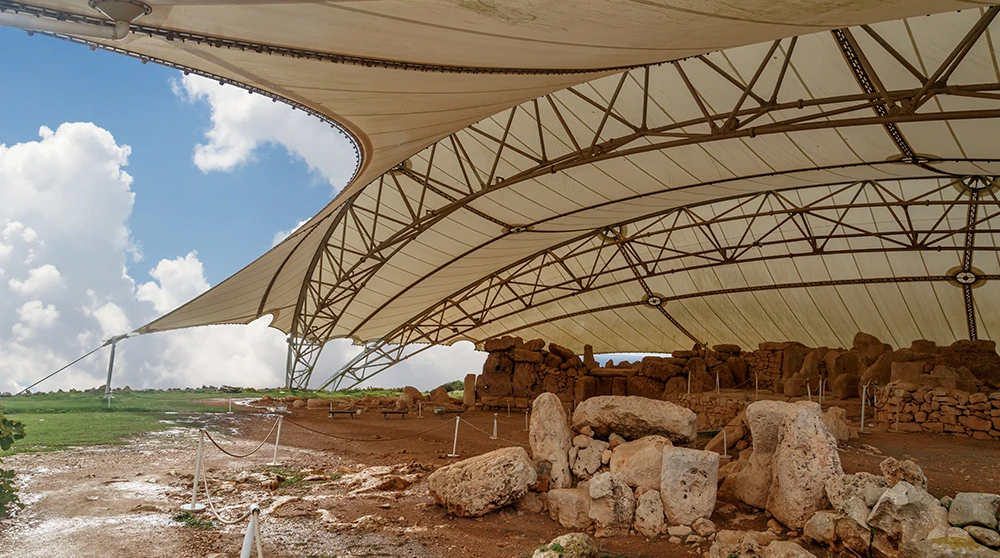
Visiting ancient ruins usually means uneven ground and harsh sunlight, but Tarxien is different. A massive, tent-like canopy covers the entire complex, protecting the delicate stones from the weather. It also means you can comfortably visit during a heavy rainstorm or the intense peak of the Maltese summer.
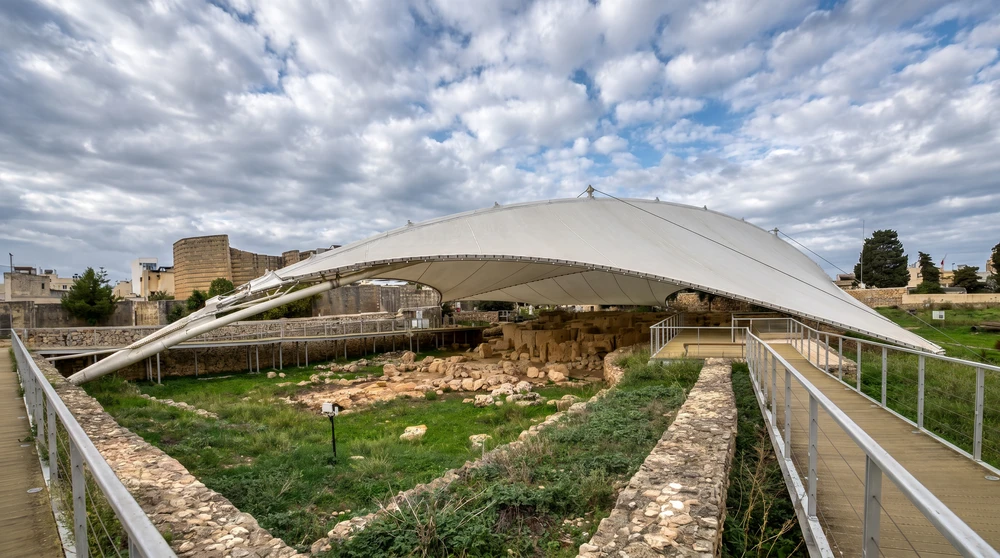
An elevated wooden walkway winds through the whole site, letting you look down into the temple chambers without touching or damaging the ruins. This design makes the complex genuinely friendly for wheelchairs and families with strollers. If you have limited mobility or young children, this is one of the easiest temples on the island to visit.
Using the QR Audio Guide
Scanning the QR code at the entrance gives you access to a free audio guide that breaks the site's history into short, digestible chunks. It saves you from squinting at faded information boards under the bright sun.
The audio app sometimes glitches on Android devices, so if you use an Android phone, bring headphones and expect minor skipping. iOS users generally have no trouble streaming the guide.
How to Get to Tarxien Temples
Getting here is straightforward. Several public buses run directly from the main terminal in Valletta to the Paola and Tarxien area, including lines 81, 82, 84, 85, and 88. The ride takes about 20 minutes, followed by a short 5-minute walk through the suburban streets.
Parking right next to the site is almost impossible because of the narrow residential roads. Using the bus or a ride-hailing app is much smarter than renting a car for this particular visit. If you want the full picture on routes, tickets, and timetables, our overview of Malta's public transport explains how the bus network works.
The temples also sit close to the Three Cities across the Grand Harbour, so it is easy to pair a morning here with an afternoon exploring Vittoriosa, Senglea, and Cospicua.
Combining Tarxien with the Hypogeum
The Hal Saflieni Hypogeum is arguably Malta's most famous underground site, and it is located just a 10-minute walk from Tarxien. Because the Hypogeum requires booking months in advance and strictly limits visitor numbers, Tarxien acts as the perfect companion site.
If you manage to secure a Hypogeum ticket, walk over to Tarxien right after your underground tour. If you miss out on the Hypogeum, Tarxien is a fantastic, crowd-free alternative you can visit on a whim without any reservation. Travelers planning several Heritage Malta sites should also weigh up the Heritage Malta Pass options before buying individual tickets.
Tarxien Temples vs. Hagar Qim and Ggantija
Many travelers debate which megalithic site to prioritize. Hagar Qim and Mnajdra offer dramatic coastal cliffs and ocean views, which give them a more rugged, cinematic atmosphere. Over on Gozo, the Ggantija Temples are older still and hold the title of the world's oldest free-standing structures.
Tarxien lacks those epic sea views because it is tucked behind townhouses. Where it wins is artistic detail, complex architecture, and ease of access. If you have young children, mobility needs, or only an hour to spare before heading to the airport, Tarxien is the smarter choice.