Most people hike all the way up to Burg Gutenberg expecting a full medieval castle tour, only to find the main doors locked tight. Knowing exactly which parts of the fortress are accessible and when saves you from a frustrating uphill walk with nothing to show for it. The true payoff here is the panoramic view from the courtyard and a couple of well-kept secrets along the trail.
- Entry: free (courtyard and outer grounds)
- Courtyard hours: daily 10:00 AM to 7:00 PM, May 1 to October 31
- Outer bailey: accessible year-round
- Rose garden and chapel: Sundays only, 10:00 AM to 5:00 PM, May through October
- Time needed: 1 to 1.5 hours (including the walk up)
- Parking: free at the base near St. Nicholas Church
- No toilets at the top — use facilities before you climb
What to Expect: The Walk Up and Courtyard
The ascent from the village takes about 15 to 20 minutes on a steep but well-paved path. You pass directly through terraced vineyards built into the slopes, and the stone walls lining the trail are home to dozens of small lizards basking in the afternoon sun.
Once you reach the top, the outer bailey opens up with enough space to walk around comfortably. The view stretches uninterrupted across the Rhine Valley into neighboring Switzerland, with the Swiss Alps forming the backdrop on clear days. Sunset visits are particularly rewarding for photography: the light hits the castle walls at a low angle and the valley fills with a warm haze.
Information plaques about the castle's history are scattered around the courtyard, though they are written almost entirely in German. If you read German, you will get much more from the visit. If not, the scenery carries the experience on its own.
The castle sits on a 70-meter-high hill, and that elevation translates into a genuine 360-degree panorama that you simply cannot get from the valley floor. On a clear day you can identify Vaduz Castle to the north and the outskirts of Sargans in Switzerland to the south.
A drinking water faucet is available in the courtyard, which is genuinely useful on warm days after the climb.
The Grassy Hill Viewpoint
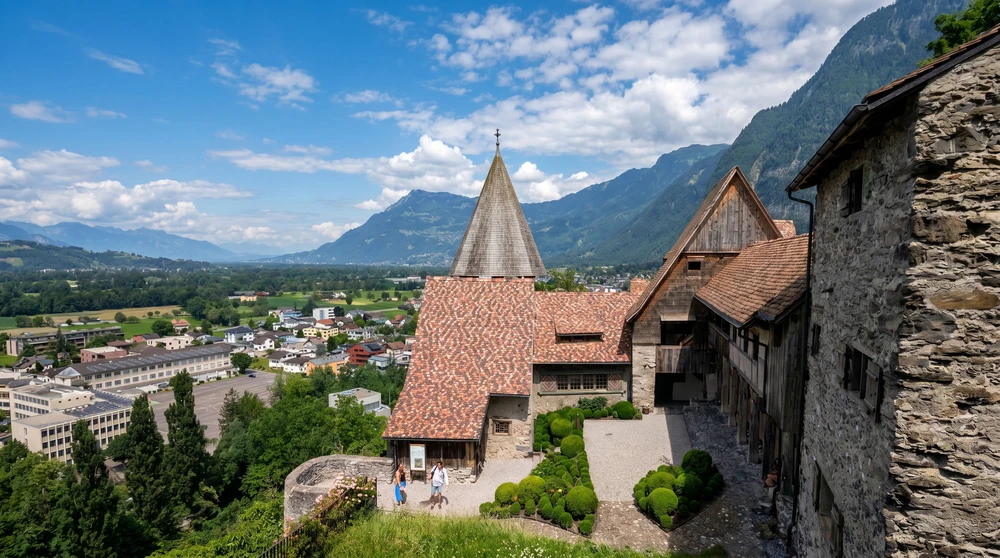
Just before the final ascent to the main gate, look for a small grassy mound on your left. Climbing it gives you the best panoramic angle of the entire area, framing the fortress against the Swiss Alps without modern buildings in the shot. Most visitors walk straight past it, which means you often have the spot to yourself.
This vantage point also lets you appreciate the full scale of Egon Rheinberger's 1905 restoration. The castle silhouette looks genuinely medieval from here, which makes it easy to forget that most of what you see is less than 120 years old.
Can You Go Inside Burg Gutenberg?
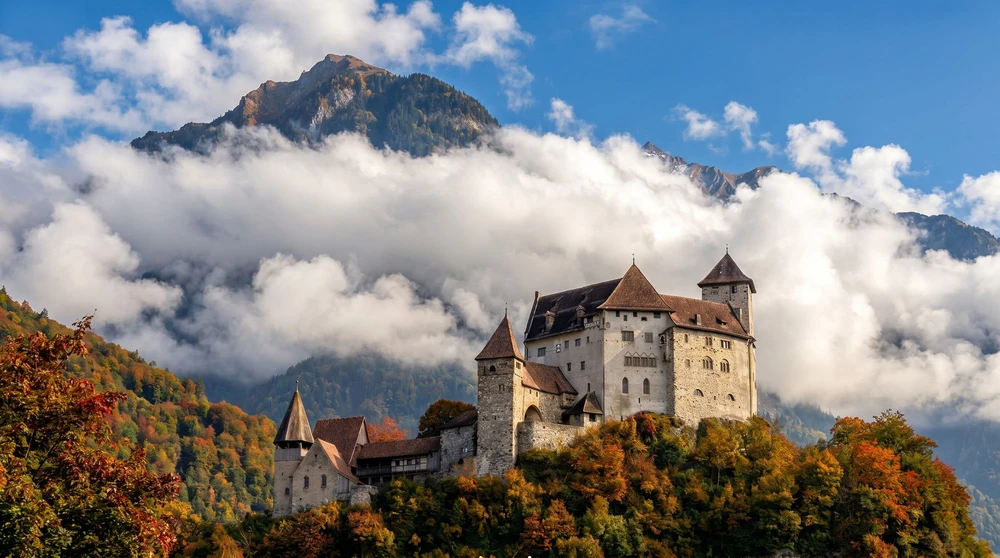
The short answer is no, not on a regular visit. The living quarters and main interior rooms stay locked to the general public. The castle functions as a state-owned monument used primarily for private events, weddings, and summer concerts.
That said, two access options exist beyond just the outer walls.
Sundays in summer (May 1 to October 31) - see best time to visit Liechtenstein for seasonal access details: Between 10:00 AM and 5:00 PM, the gates open wider to let visitors into the rose garden and the historic castle chapel. The rose garden was reconstructed in 2010 and is at its best in late June. Access can still close unexpectedly if the state schedules a private event that day, so arriving early improves your chances.
Private guided tours: The municipality of Balzers offers guided tours of the interior rooms, but you need to book at least two weeks in advance through the official channels (website: burg-gutenberg.li, phone: +423 384 55 77). These tours walk you through the full history of the grounds, including one particularly odd detail: Liechtenstein's very first bowling alley is hidden inside the castle, installed during Rheinberger's era.
A Brief History
The Gutenberg hill has been inhabited since the Neolithic period. Archaeological excavations uncovered the Mars von Gutenberg figurine, a 12 cm ancient bronze artifact now on display at the Liechtenstein National Museum in Vaduz, worth stopping to see if you are visiting the capital.
Construction of the fortified castle began around 1100. The structure passed through the hands of Swiss nobility, then the House of Habsburg from 1314 onward. By the 19th century it had fallen into serious ruin.
The castle's current appearance is almost entirely the work of Vaduz-born architect and sculptor Egon Rheinberger, who bought the crumbling remains in 1905 and oversaw a full reconstruction through 1912. He rebuilt the main structures based on surviving stonework and added the chapel, a chaplain's house, and a smithy. From the 1920s until his death in 1936, the castle operated as a guesthouse and cultural venue. The Liechtenstein government acquired it in 1979 and holds it jointly with the municipality today.
How to Get There
Balzers sits in the southern tip of the country, making the castle visible from most directions. Getting the starting point right saves unnecessary detours.
By car: Do not follow GPS blindly up the hill. The roads immediately near the castle are restricted to local traffic only. Park in the free spaces near St. Nicholas Church at the base of the hill. From there, the pedestrian path up is clearly marked.
By bus: Bus 11 runs regularly from Vaduz directly to Balzers. (See the guide to getting around Liechtenstein for full bus schedules.) Get off near the church and the trail starts right there. A practical routing tip: visit Vaduz and Vaduz Castle first, then take the bus south and make Burg Gutenberg your last stop before crossing into Switzerland toward Sargans. You can also combine it with the nearby Liechtenstein Trail, which passes through Balzers as part of its full north-south route.
If you are planning a full day in the country, the Liechtenstein Adventure Pass covers public transport across the entire principality, including the bus connection to Balzers, and can make the logistics significantly simpler.
Budget travelers will find the castle fits neatly into the broader picture of what Liechtenstein costs: Liechtenstein travel costs are low by European standards once you skip the expensive restaurants near Vaduz's main street.
For anyone still deciding where to base themselves, the where to stay in Liechtenstein overview covers options across the entire country, including whether staying in Balzers itself makes sense for a southern-focused itinerary.