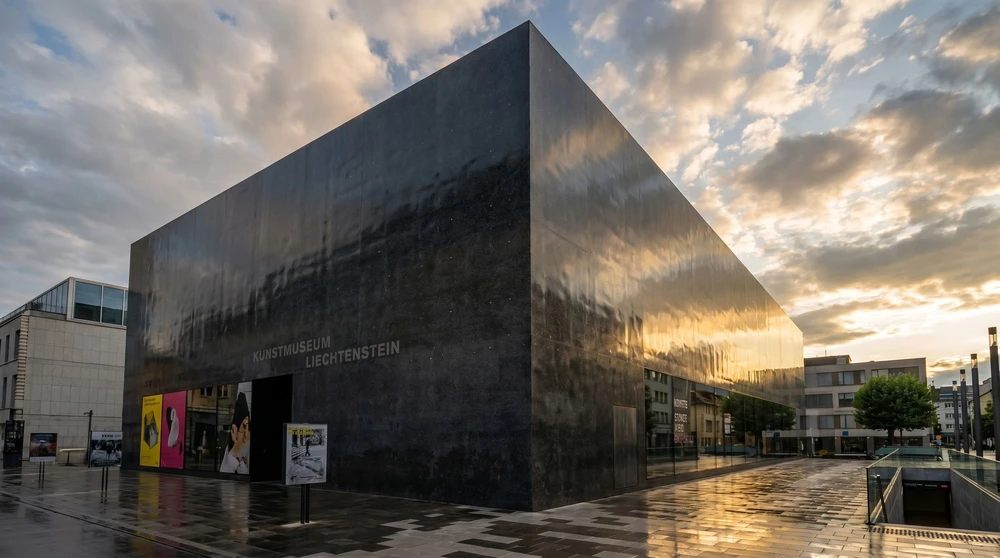
The black basalt cube on Äulestrasse is easy to miss if you arrive in Vaduz expecting a conventional museum. It blends into the streetscape until you notice the polished facade catching the light off the Rhine valley. Inside, it holds the national art collection of Liechtenstein alongside one of the most focused classical modernism collections in the Alpine region.
- Combined ticket (Kunstmuseum + Hilti Art Foundation): CHF 15 adults, CHF 10 reduced (2026)
- Free admission every Wednesday for all visitors
- Children 16 and under: free at all times
- Open Tue-Sun 10:00-17:00, Thu until 20:00, closed Mondays
- Address: Äulestrasse 32, Vaduz
- Fully wheelchair accessible throughout both buildings
The Architecture: A Black Basalt Box That Earns Its Reputation
Designed by Swiss architects Meinrad Morger, Heinrich Degelo, and Christian Kerez, the building opened on November 12, 2000 and has become one of the most discussed museum buildings in Central Europe. The exterior is tinted concrete studded with black basalt stone and river pebbles sourced from the Rhine. The polished surface reflects the surrounding alpine landscape differently at every hour of the day.
Inside, six exhibition rooms are arranged around two diametrically opposed staircases, creating diagonal sightlines that draw your eye through multiple spaces at once. The contrast is deliberate: stark white walls, light oak floors, and carefully controlled natural light from skylights. The architecture does not compete with the art. It frames it.
Kunstmuseum Liechtenstein: The Contemporary Collection
The permanent collection focuses on 20th and 21st-century international art, with no geographic or stylistic restriction on acquisitions. That open brief has produced a collection strong in Arte Povera, post-minimalism, and conceptual installation. Works by Richard Serra and Donald Judd entered the collection through a joint acquisition of the Rolf Ricke collection in 2007, shared with two partner institutions.
Temporary exhibitions rotate regularly, occupying the main gallery spaces alongside the permanent holdings. The high ceilings and generous floor area allow large-scale installations to breathe in ways that many bigger institutions cannot manage. If you visit twice a year apart, you will likely see a substantially different show each time.
The Hilti Art Foundation: Classical Modernism Next Door
In 2015, a second building opened directly adjacent to the Kunstmuseum: the Hilti Art Foundation, designed by Basel-based architects Morger + Dettli. The two buildings connect via an underground passage, and your single admission ticket covers both.
The Hilti collection represents the private holdings of the Martin Hilti family trust and the Caroline and Michael Hilti collection, assembled systematically since 1997. The roughly 200 works span European classical modernism from around 1880 to 1950 and continue through to contemporary pieces. The collection includes paintings and sculptures by Gauguin, Picasso, Léger, Beckmann, Kirchner, Klee, Kandinsky, Giacometti, Dubuffet, and others. Focal points are Expressionism, Cubism, Constructivism, Surrealism, Concrete Art, and abstract painting after 1980.
The building is organized across three levels by theme and chronological era. The intimate scale and consistent climate control suit the works well. You are unlikely to feel rushed here, and the absence of tour-group crowds that plague major European collections is a genuine advantage.
Tickets and Free Admission Days
A standard adult ticket is CHF 15, which covers both buildings and all current exhibitions. Reduced admission of CHF 10 applies to seniors, students, apprentices, disabled visitors, and groups of ten or more. Children and adolescents 16 and under enter free.
Every Wednesday, admission is free for everyone, including participation in any public guided tour or event scheduled that day. If your Liechtenstein visit falls mid-week, Wednesday is the obvious target. The museum also opens free on August 15, Liechtenstein's National Day.
Guided tours are included in the general admission price and run on a regular public schedule. Private group tours in English or German start at CHF 150 and require booking at least one week in advance.
Getting to the Museum
Vaduz has no train station, a fact that catches many first-time visitors off guard. The standard approach is the **LIEmobil bus network**: buses run from Sargans (Switzerland) and Feldkirch (Austria), both of which sit on international rail lines. The stop is Vaduz Post, a short walk from the museum entrance on Äulestrasse.
If you are combining the Kunstmuseum with visiting Vaduz Castle and the old town, the entire circuit is walkable. The town center is compact enough that you do not need a vehicle once you arrive.
Drivers will find paid parking garages within two to five minutes of the museum in central Vaduz. Note that road construction on Äulestrasse has periodically restricted traffic to a single lane in recent years, so the bus remains the faster and simpler option during peak months. See the guide to best time to visit Liechtenstein for seasonal crowd levels. If you are arriving from Zurich, the Liechtenstein day trip from Zurich by train-and-bus combination is straightforward and takes under two hours each way.
Planning Your Visit to Vaduz
The Kunstmuseum and Hilti Art Foundation together take most visitors between 1.5 and 3 hours, depending on engagement with the temporary exhibitions. A Thursday evening visit until 20:00 is consistently quieter than weekend afternoons. Mornings right after the 10:00 opening guarantee nearly empty galleries.
The museum sits at the center of a broader Vaduz itinerary. The Liechtenstein passport stamp available at the tourist office nearby makes for an easy stop before or after your visit. If you are planning a full day or multiple days in the principality, the Liechtenstein Adventure Pass covers a range of attractions across the country worth considering.
Budget-conscious visitors benefit most from a Wednesday visit. The free entry, combined with the fact that the combined ticket already represents strong value against comparable institutions in Zurich or Vienna, makes this one of the more accessible premium museum experiences in the region. Those tracking Liechtenstein travel costs overall will find the museum fits comfortably into even a tight daily budget when timed correctly.