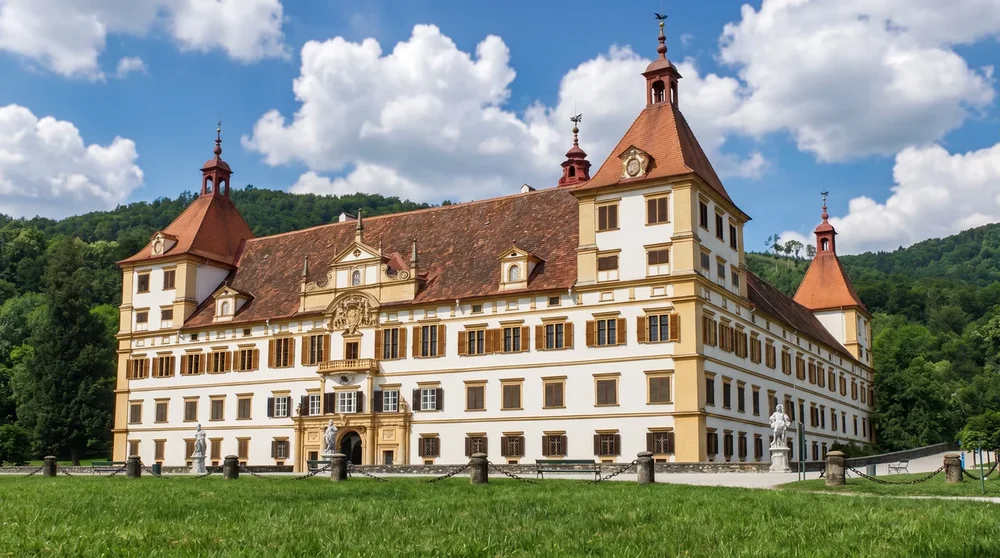
Eggenberg Palace is Graz's most significant baroque estate and a UNESCO World Heritage Site sitting just outside the city center. Built in the early 17th century for Hans Ulrich von Eggenberg, the palace doubles as an architectural calendar, every detail of its layout encodes a unit of time. If you plan to see the famous State Rooms, you need to arrive prepared: access is exclusively via mandatory guided tours that run at fixed times on a limited daily schedule.
- State rooms ticket (adults): €20 (includes guided tour)
- Gardens only (adults): €3
- Children under 6: Free
- Season: State rooms and museums open March 28 - October 31, Tue-Sun
- Gardens: Open year-round daily
- Guided tour languages: German, English, Italian, French (group bookings)
- Photography: Strictly prohibited inside the State Rooms
Why You Need a Guided Tour for the State Rooms
The 24 State Rooms operate without modern heating or electricity to protect the fragile artworks. The interiors are naturally dim, the atmosphere authentic. You cannot wander through these corridors alone. A guided tour is mandatory. English tours run at specific hours throughout the day, so checking the daily schedule upon arrival saves you from waiting. If you miss the tour slot, you only see the exterior. Group bookings for private tours in English, Italian, or French require at least 7 people and one week advance notice.
Decoding the Architecture: The Calendar Symbolism
The entire complex acts as a massive architectural calendar. The design features exactly 365 windows, representing the days of the year. The layout contains 31 rooms per floor for the days of the month, 24 state rooms for the hours of the day, and four towers marking the four seasons. The Planetensaal (Planetary Hall) features ceiling paintings blending mythology with astrology across more than 500 ceiling paintings throughout the palace. The symbolism is mathematically precise and unlike anything else in Central Europe.
Museums Inside the Palace Complex
Beyond the state rooms, the complex houses several distinct collections within the same ticket or as separate admissions.
Alte Galerie
This section holds European art spanning from the Middle Ages to the Baroque period. The exhibition rooms display works from masters including Pieter Brueghel. The lighting is kept low to preserve the canvas pigments.
Archaeology Museum and Coin Cabinet
The lower floors contain Roman artifacts and ancient regional discoveries. The Coin Cabinet showcases currency evolution across the empire. The displays are highly detailed and well-labeled in English.
How to Get to Eggenberg Palace from Graz City Center
Reaching the estate from the main train station or city center requires just a short public transport ride.
Tram Line 1 vs. Tram Line 7
Board Tram Line 1 heading towards Eggenberg/UKH and get off at the Schloss Eggenberg stop. From there, a brief walk along the estate wall leads directly to the entrance. Alternatively, Tram Line 7 towards Wetzelsdorf drops you at Eggenberger Allee. The path from Tram Line 1 is slightly more direct and takes around 15 minutes from the city center.
Parking Options Near the Palace
Driving to the estate is an option. Free parking is available at the nearby Erlebnisbrauerei Rudolf for the duration of your visit. Street parking in the surrounding area requires a valid parking ticket.
Best Time to Visit the Gardens and Park
The expansive park features wide walking paths covered in white pebbles. Peacocks roam freely across the lawns throughout the warmer months. The environment is calm, the trees incredibly tall. Spring and early summer offer the best floral displays in the Planetary Garden, a landscaped garden considered among the most precious garden monuments in Austria. During the winter months the palace interiors remain closed, but the garden paths stay open year-round for a quiet walk.
If you enjoy visiting historical palace complexes across Europe, the Palace of the Grand Dukes of Lithuania in Vilnius offers a similarly absorbing mix of reconstructed royal interiors and guided access. For a deeper European museum experience, the National Museum of Lithuania in Vilnius covers the region's layered history in comparable detail. Art collectors visiting Florence will also find the Leonardo da Vinci Museum a worthwhile stop before or after any Austrian itinerary.