Florence is a city where art does not just live inside museums. It spills out onto the streets, climbs the walls and stands boldly in the squares. If you are looking for the very heart of this artistic explosion, you do not need a ticket or a reservation. You just need to walk into Piazza della Signoria.
This is not merely a square; it is a stage where the history of Florence has played out for centuries and where political power meets artistic genius.
Most visitors rush through here on their way to the Uffizi Gallery, snapping a few photos without realizing what they are looking at. But you will do it differently. You will understand why that statue is looking in that specific direction and you will know exactly where to look on the ground to find a hidden piece of history that most people step right over.
Why Piazza della Signoria is Florence's Heartbeat
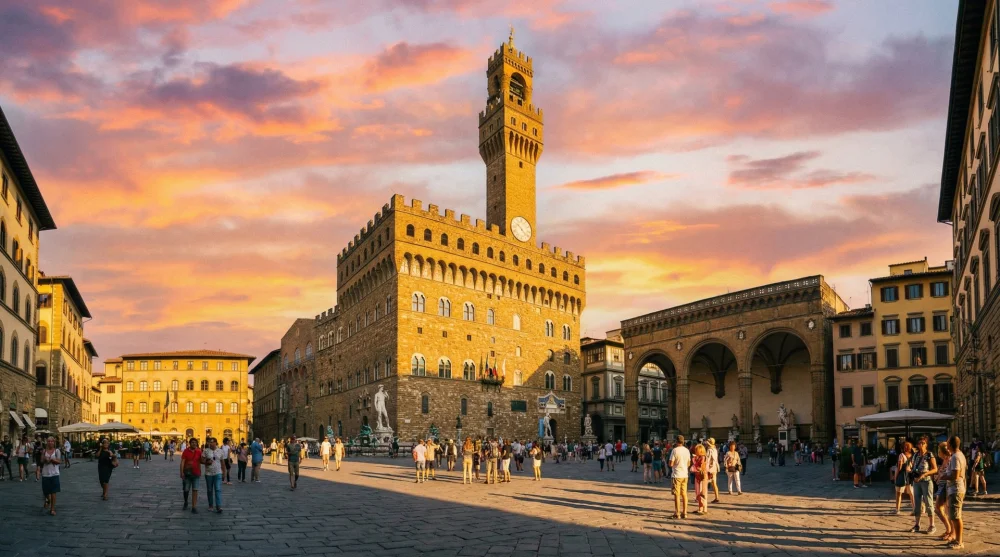
This L-shaped square has been the center of political life in Florence since the 14th century. While the Duomo represents the religious heart of the city, Piazza della Signoria is its civic brain. The massive fortress you see dominating the space is the Palazzo Vecchio, the town hall. It looks more like a castle ready for war than an office building, which tells you a lot about the turbulent history of this republic.
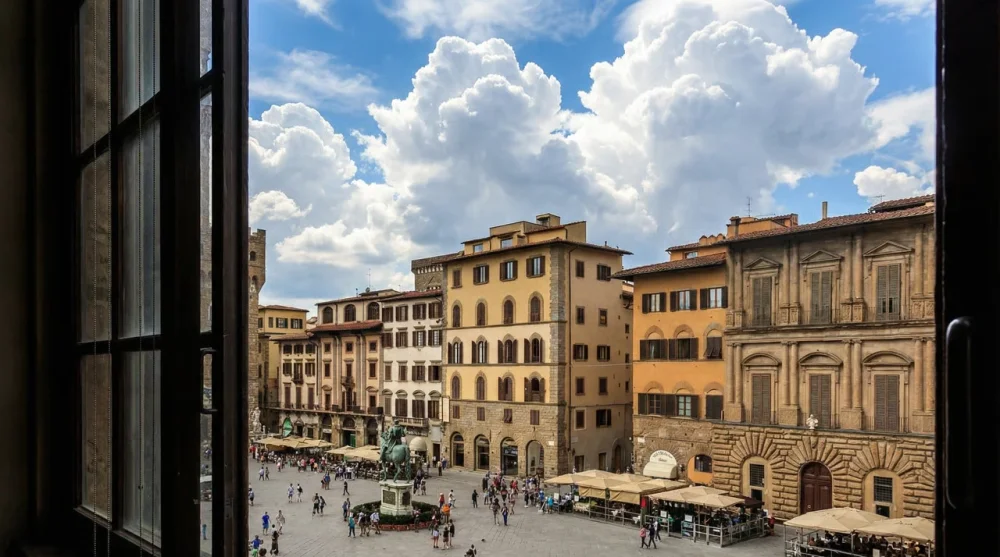
For you, this means the square is alive 24/7. In the morning, delivery trucks and sleepy locals cross the cobblestones. By midday, it buzzes with languages from every corner of the globe. At night, the atmosphere transforms completely. The stone walls cool down, street musicians, usually playing classical violin or guitar, set up near the Loggia, and the lighting gives the statues a dramatic, almost ghostly appearance. It is arguably the best time to experience without the overwhelming crowds.
The Statues: An Open-Air Masterpiece Walk
You are standing in what is essentially a free open-air museum. The statues here were not placed randomly; each one carries a political message or a symbol of power meant to impress (or intimidate) the citizens of Florence.
Michelangelo’s David (The Replica)
Standing guard right in front of the Palazzo Vecchio entrance is one of the most famous silhouettes in the world. Yes, this is a copy. The original David stood in this exact spot from 1504 until 1873, when it was moved to the Accademia Gallery to protect it from the weather.
Even though it is a replica, seeing David here gives you the context Michelangelo intended. He is not just a beautiful boy; he is a symbol of the small Florentine Republic standing up against giant enemies. His eyes are fixed towards Rome, warning powerful rivals that Florence is always watching and ready to fight.
Hercules and Cacus
To the right of David, you will see a muscular figure clubbing a crouching enemy. This is Hercules and Cacus by Baccio Bandinelli. Here is a bit of local gossip from the Renaissance: Bandinelli was a rival of Michelangelo and he desperately wanted to prove he was just as good.
When this statue was unveiled, the Florentines were not kind. They mocked it, saying the muscles looked like a sack full of melons. While it might not have the divine grace of Michelangelo's work, it represents the physical strength of the Medici family, complementing David's spiritual strength.
The Fountain of Neptune (Il Biancone)
As you move towards the corner of the Palazzo Vecchio, you cannot miss the massive white marble figure towering over a fountain. This is Neptune, representing the Florentine naval ambition. Locals affectionately (and sometimes mockingly) call him Il Biancone or The White Giant.
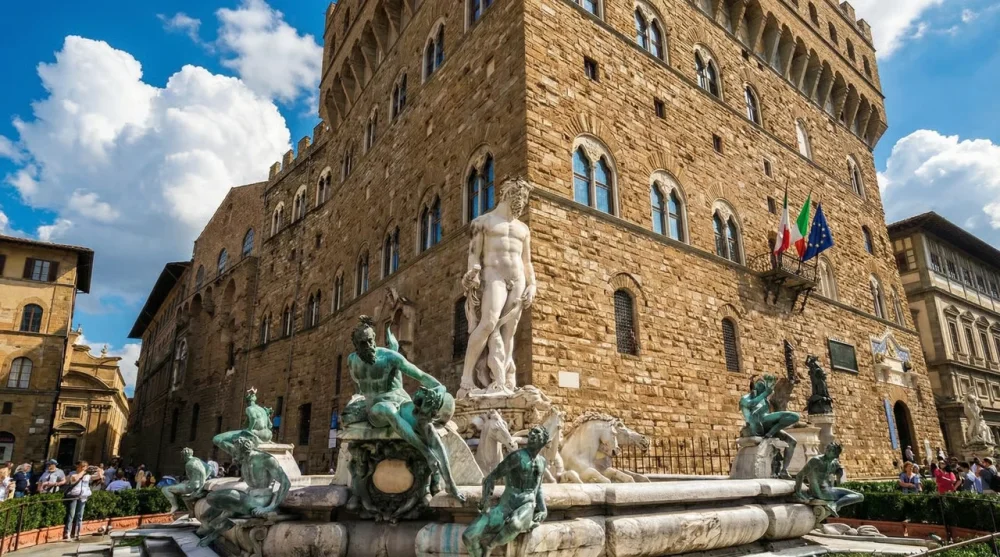
When Bartolomeo Ammannati finished this work, the people of Florence joked that he had ruined a beautiful piece of marble. Despite the harsh critics of the past, today the fountain is a stunning sight, especially since the recent restoration. The bronze satyrs and sea horses surrounding the basin are full of movement and intricate detail.
Equestrian Statue of Cosimo I
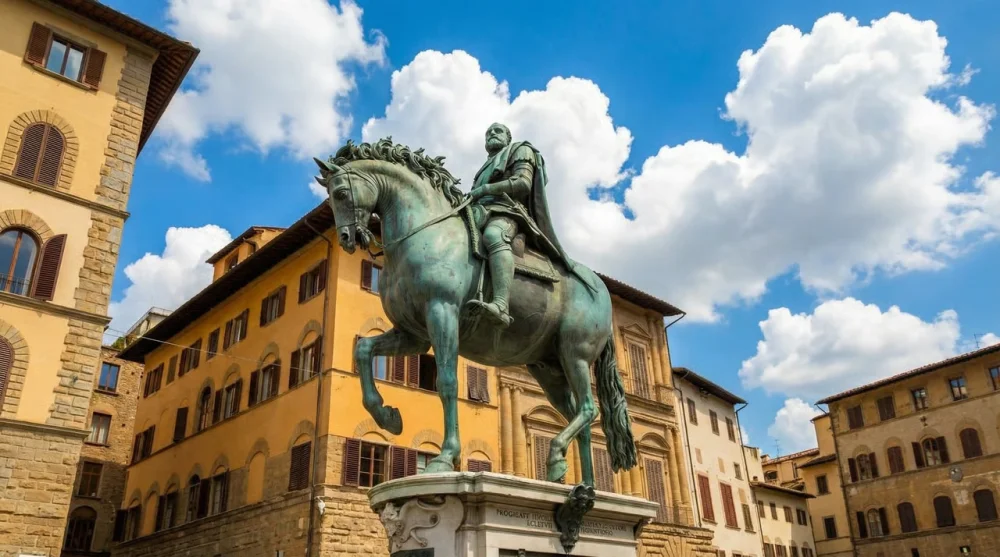
Dominating the center of the square is the bronze statue of Cosimo I de' Medici on horseback. He was the man who managed to bring all of Tuscany under Medici rule. The statue, created by Giambologna, shows him as a majestic military leader, calmly controlling his horse, just as he controlled the state.
Loggia dei Lanzi: The Free Sculpture Gallery
On the south side of the square, you will find a beautiful arched structure. This is the Loggia dei Lanzi. Originally built for hosting public ceremonies, it now serves as a shelter for some of the most intense sculptures you will ever see. It is the perfect place to sit and people-watch if it starts to rain or if the sun gets too hot.
Perseus with the Head of Medusa
On the left corner stands a bronze statue that demands your attention. Perseus stands triumphantly over the headless body of Medusa, holding her severed head aloft. This masterpiece by Benvenuto Cellini is incredible not just for its artistic quality but for the technical difficulty of casting bronze in such a complex shape.
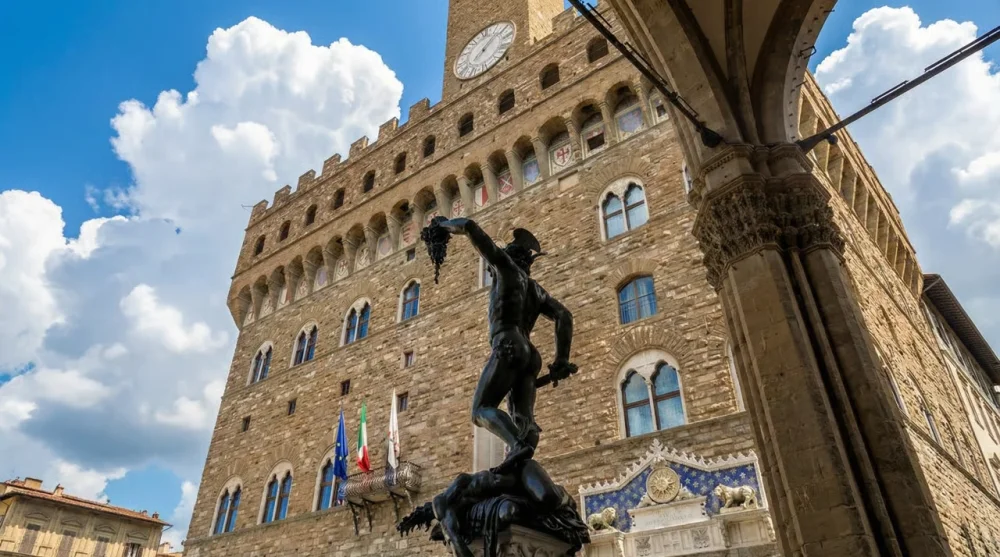
Cellini nearly burned down his house and threw all his pewter plates into the melting pot to get the metal to flow correctly. The message was clear to the enemies of the Medici duke: this is what happens to those who cross us.
The Rape of the Sabine Women
Further back in the Loggia is a swirling mass of three marble figures carved from a single block of stone by Giambologna. Walk around this statue. It has no single front view; it is designed to be viewed from all angles, spiraling upwards in a display of fear, struggle and power. It is a masterclass in movement frozen in stone.
Hidden Gems in the Square
Most people look up at the towers and statues, but you should look down. Near the Fountain of Neptune, search for a round porphyry slab set into the pavement.
This marks the exact spot where the fanatical monk Girolamo Savonarola was burned at the stake in 1498. He had previously organized the Bonfire of the Vanities in this same square, burning art, books and mirrors he considered sinful. Eventually, the city turned against him, and he met a fiery end right here.
Another secret requires sharp eyes. Go to the entrance of Palazzo Vecchio, near the Hercules statue. Look closely at the stone wall behind it. You might find a simple profile of a man's face carved into the rough stone. Legend says this is L'Importuno (The Nuisance). The story goes that Michelangelo was being bored by a talkative man and, with his hands behind his back, carved this profile into the wall just to pass the time.
Practical Tips for Visiting
Best Time to Visit: If you want photos without hundreds of people in the background, you need to be here before 08:00 AM. However, the most magical atmosphere is after sunset. The day trippers have left, and the square returns to the locals.
Avoiding Tourist Traps: This is critical for your wallet. The restaurants lining Piazza della Signoria offer a great view, but you pay a premium for it. Prices here can be significantly higher than just two streets away. If you sit down, check if there is a coperto (cover charge) or service fee added.
For a more authentic and budget-friendly experience, grab a panino from a nearby shop (the famous All'Antico Vinaio is just behind the Uffizi) and eat it while sitting on the stone benches of the Loggia dei Lanzi, watching the world go by. It is the best dining view in the city and it is completely free.
Safety: The square is generally very safe, but like any crowded tourist spot, pickpockets can be active. Keep your bag closed and in front of you, especially when you are distracted looking up at the statues or watching a street performer.
How to Get There
Piazza della Signoria is in the pedestrian heart of Florence. It is impossible to miss.
- From the Duomo: Walk south on Via dei Calzaiuoli for about 5 minutes.
- From the Ponte Vecchio: Walk north on Via Por Santa Maria for 3 minutes.
- From Santa Maria Novella Station: It is a pleasant 15-minute walk through the city center.
You will likely find yourself crossing this square multiple times during your stay in Florence. Each time you do, take a moment to look at a different detail. It is a place that rewards curiosity.