Walking through Kingston without understanding the layers of misery beneath your feet turns a UNESCO World Heritage site into just another collection of old stone walls. The Kingston and Arthur's Vale Historic Area (KAVHA) packs two brutal penal settlements, a working cemetery, and some of the best-preserved Georgian architecture in the Pacific into a single walkable waterfront zone. Here is how to read the ruins, what the museums actually cover, and how to plan a visit that does the site justice.
The Dark History Behind Kingston and Arthur's Vale
The Penal Settlements (1788-1855)
The British established the first penal colony here in 1788, weeks after settling Sydney, primarily to secure timber and flax for the navy. That first settlement was abandoned within a decade. The sprawling ruins you walk through today mostly belong to the second settlement (1825-1855), which the colonial administration deliberately designed for the worst re-offenders from mainland Australia.
Conditions were harsh under a string of strict military commandants. Historical records show convicts sometimes committed capital crimes simply to escape hard labor through execution rather than endure another sentence. The scale of the stone structures built by chained convict gangs, quarried and dressed by hand, remains the most visible evidence of forced labor left anywhere in the Pacific.
From Penal Colony to Settlement
The penal era ended in 1855, and the buildings sat largely empty until 1856, when the British government resettled the abandoned colony with the descendants of the HMS Bounty mutineers, relocated from an overcrowded Pitcairn Island. That population shift is the origin of Norfolk Island's modern community and Norfuk language, both of which have their own story beyond the historic site itself.
Key Historical Buildings to Explore
Quality Row and Georgian Architecture
Quality Row is an immaculate run of Georgian military and civilian housing along the waterfront. The symmetrical stone facades and rigid layout were designed to project military control, and the placement itself tells you who held power: officers and administrators lived here, separated from the convicts who labored in the marshland below.
House No. 10 stands out as the one property fully restored and furnished to its 1844 state. Walking through its rooms gives you a direct look at the comparatively comfortable domestic life of a senior free settler, in sharp contrast to the convict barracks nearby.
The New Military Barracks and Commissariat Store
The New Military Barracks sit on the high ground above Kingston, built with massive perimeter walls and watch points that still dominate the skyline. Officers were stationed here, physically and socially removed from the convict compounds below. The building now houses local government offices, but the exterior is unchanged and worth the short climb for the view over the bay.
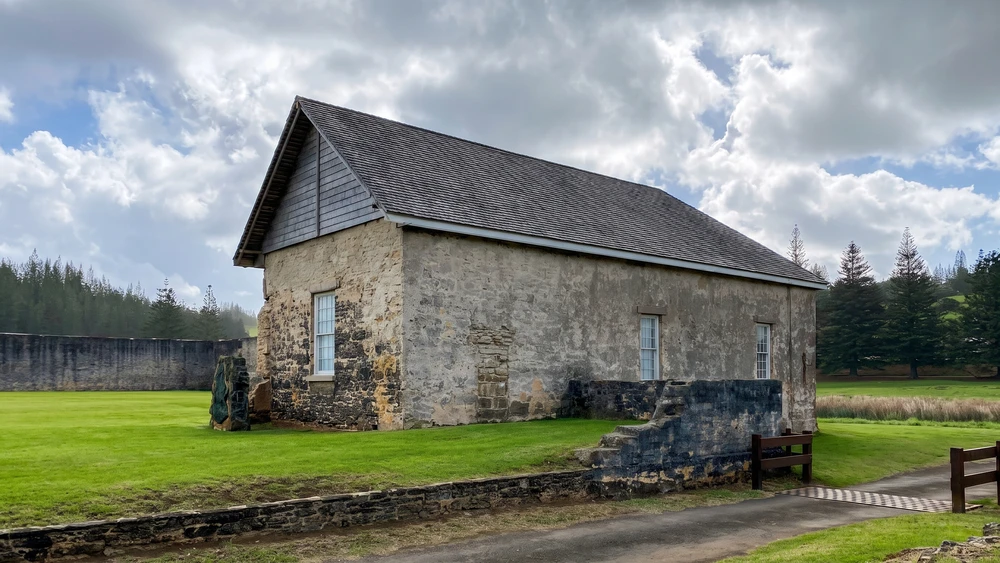
Down at the shoreline, the Commissariat Store once held the colony's food and supply lifeline. Its ground floor is now All Saints Church, while sections of the building have historically operated as part of the Norfolk Island Museum. Exhibit access changes from time to time, so confirm which buildings are open before you plan your route through the day.
The Convict Cemetery
At the eastern edge of the historic area, the convict cemetery sits directly against the coastline. The headstones function as primary historical documents, carved with skulls, crossbones, and hourglasses, and inscribed with details of executions, murders, and accidents. The layout mirrors the social hierarchy of the settlement: free settlers, military personnel, and their families rest in marked, consecrated ground, while executed prisoners were buried in unmarked plots outside the original boundary.
A guided cemetery tour runs on select mornings and adds context you will not get from the headstones alone, including which graves belong to notable figures from the settlement's records.
Practical Information for Visitors
The outdoor grounds, ruins, and cemetery at KAVHA are free to walk and open 24 hours a day. You only need a ticket for the four indoor heritage exhibitions run by the Norfolk Island Museum: the Pier Store, the HMS Sirius Museum, No. 10 Quality Row, and the Commissariat Store when it is open to visitors.
A single museum entry costs $12 AUD. If you plan to see more than one exhibition, the Museum Multi Pass is better value at $43 AUD, which covers unlimited entries across your stay plus two guided Tag-A-Long tours. School-age children enter free when accompanied by an adult Multi Pass holder. The separate guided cemetery tour costs $24 AUD on its own, or a reduced rate with the Multi Pass.
Buy tickets at the R.E.O. (Royal Engineer's Office) building near the pier, which also functions as the visitor information point and museum shop for the site.
Inside the HMS Sirius Museum
The HMS Sirius Museum is small but dense with substance. The exhibition centers on the wreck of the HMS Sirius, the flagship of the First Fleet that ran aground on the Slaughter Bay reef in 1790, and it includes footage from an archaeological dive that recovered pieces of the ship. Knowledgeable guides bring the shipwreck's story to life, making it a reliable stop even if you only have time for one of the four exhibitions.
Opening Hours and Getting There
Museum exhibitions run 11:00 AM to 3:00 PM, Monday through Saturday. On Sundays, only the Pier Store is open on the same 11:00 AM to 3:00 PM schedule; the rest of the indoor exhibitions are closed. The outdoor ruins and cemetery remain accessible every day regardless of museum hours.
Renting a car gives you the most flexibility for reaching KAVHA and exploring at your own pace. Free parking is available along the waterfront near the main museum buildings and the entrance closest to Slaughter Bay. The historic area itself is flat and walkable, and most visitors need 4-5 hours to cover the ruins, cemetery, and at least two of the indoor museums without rushing.
Bounty Museum & Norfolk Island Heritage Centre: A Separate Stop Worth Planning For
Not every history museum on Norfolk Island is part of the official KAVHA ticket group. The privately run Bounty Museum & Norfolk Island Heritage Centre sits nearby and operates completely independently, with its own entry fee and a very different visiting style. It is far bigger than it looks from outside, and most people need two hours or more to see everything on a first visit.
What sets it apart is the hands-on approach. Instead of glass cabinets, most artifacts sit out on open tables and benches, many donated directly by island families, and staff actively encourage visitors to pick up items like the original convict ball and chain to feel its weight for themselves. The single entry fee covers unlimited return visits for the length of your stay, the smart way to avoid museum overload in one sitting. The building also doubles as the home of the local radio station, so a visit here often means a genuine chat with an islander at the front desk.
Because the KAVHA museums and the Bounty Museum sell separate tickets on separate schedules, budget your visit as two distinct stops rather than trying to squeeze both into one afternoon. Pairing an early KAVHA museum visit with an unhurried Bounty Museum session later in your stay, using its return-visit policy, gets you the most out of Kingston's history without feeling overwhelmed.