Walking between the Hagia Sophia and the Blue Mosque, thousands of visitors rush past a small green-domed pavilion without ever realizing they need to look up. Stepping directly beneath its arches reveals an unexpected masterpiece of gleaming golden mosaics, hiding a fascinating diplomatic secret right in plain sight. This is the German Fountain, one of Sultanahmet's most overlooked landmarks, and the story behind it is far more interesting than it first appears.
- Entrance: completely free, open 24 hours
- Location: northern edge of Sultanahmet Square (Hippodrome), opposite the Mausoleum of Sultan Ahmed I
- Getting there: 2-minute walk from Sultanahmet T1 tram stop
- Best time to visit: early morning or late afternoon for photography
- Accessibility: flat ground, wheelchair friendly
Why is There a German Fountain in Sultanahmet? (The Royal Gift)
Most monuments in this historic square belong to ancient empires, making a European structure feel slightly out of place. The pavilion was a strategic gift of friendship from the German Emperor Kaiser Wilhelm II to the Ottoman Sultan Abdülhamid II, presented to commemorate Wilhelm's second visit to Istanbul in October 1898.
The political goal was clear. Germany wanted to secure the lucrative Berlin-Baghdad Railway contract, a line that would connect Berlin to the Persian Gulf and open enormous commercial and military possibilities across the Ottoman lands. An elaborate royal gift served as the perfect diplomatic icebreaker, and it worked. Wilhelm secured the promise for German companies to construct the railway before he left the city.
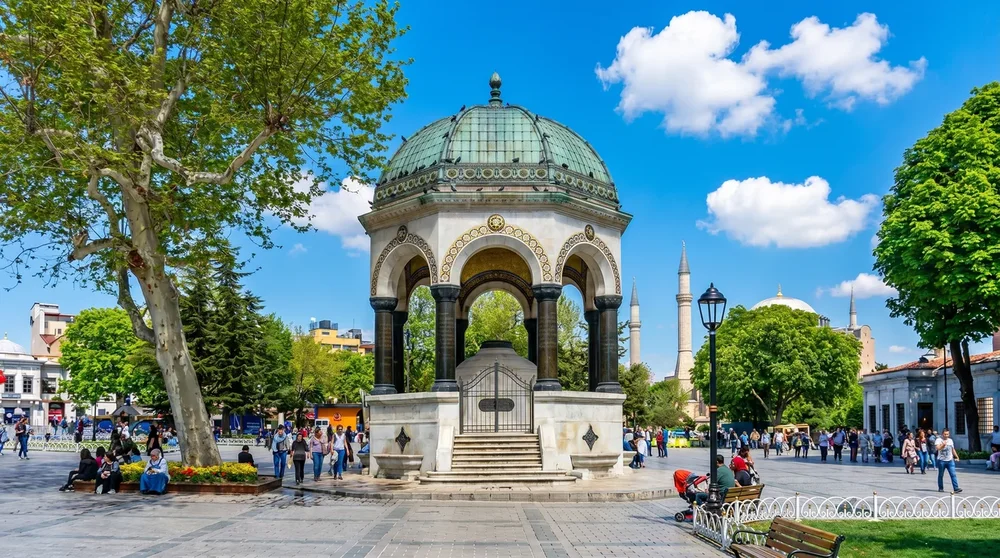
The fountain itself was manufactured entirely in Germany by architect Max Spitta, then shipped piece by piece and assembled at the entrance of the ancient Hippodrome. Construction finished in 1900, but the official inauguration was delayed until 27 January 1901, timed deliberately to coincide with Wilhelm II's birthday. Before the fountain stood here, this spot was occupied by a plane tree known as the Vakvak Tree, associated in Ottoman memory with the violent janissary rebellion of 1656.
Architectural Details: Look Up at the Golden Mosaics
Approaching the structure, the exterior presents a striking Neo-Byzantine silhouette. Eight porphyry columns support an ornate copper dome with eight steps rising to the entry gate. The real magic happens when you step inside.
Tilt your head back. The interior ceiling is a vast canvas of solid gold mosaic tiles catching the ambient light. Look closely at the intricate medallions embedded in the gold. You will spot eight monograms arranged in the stonework: the elegant tughra (seal) of Sultan Abdulhamid II on four green-background medallions, alternating with the crowned W symbol of Kaiser Wilhelm II on four Prussian-blue medallions. This interlocking design masterfully visualizes the alliance between the two powers, frozen in gold above every visitor's head.
The bronze inscription running along the reservoir records Wilhelm's words in German, translated roughly as: "Kaiser Wilhelm II endowed this fountain in thankful remembrance of his visit to Ottoman Sultan Abdulhamid II in autumn of 1898." A separate Ottoman inscription by calligrapher Hattat Izzet Efendi faces the square.
The seven brass taps surrounding the marble base are not just decorative. Water flows continuously, and visitors use them to cool off during hot summer days. The water from the taps is generally considered clean for handwashing.
Where is the German Fountain Located?
Finding this historic gem requires almost no extra effort. Take the T1 Tram line and step off at the Sultanahmet station. Walk toward the main square, keeping the majestic Hagia Sophia to your left.
The fountain sits right at the northern starting point of the ancient Hippodrome of Constantinople. It stands directly across from the Mausoleum of Sultan Ahmed I, acting as a visual anchor before you reach the Egyptian Obelisk further down the square. From here, the Serpentine Column and the Column of Constantine the Great are within a short walk along the same axis.
Best Time for Photography and Avoiding the Crowds
Tour groups flood the square by mid-morning, making it nearly impossible to capture a clean wide shot of the pavilion. Arrive just after sunrise for the most serene atmosphere. The air is crisp, the square quiet, and the green dome catches the early light in a way that midday sun cannot replicate.
If you want to capture the golden ceiling mosaics at their absolute best, late afternoon provides ideal conditions. The lowering sun angles directly beneath the arches, illuminating the golden tiles and making the intricate monograms glow against the darkening sky. Stand right in the center, point your camera straight up, and lower the exposure slightly to capture the rich contrast of the green arches against the brilliant gold.
The fountain is lit at night, making it worth a second visit after dark when the square empties out and the mosaics take on a warmer, more theatrical glow.
What Else is Nearby?
The German Fountain sits at the heart of one of the world's densest concentrations of historical monuments. Within five minutes on foot you can reach the Blue Mosque, the Hagia Sophia, the Basilica Cistern, the Egyptian Obelisk, and Topkapi Palace's outer gate. The square itself is the site of the ancient Hippodrome of Constantinople, which hosted chariot races for centuries and served as the social and political center of Byzantine life.
Plan at least a half day in Sultanahmet to do the area justice. The German Fountain itself takes no more than 15-20 minutes to examine thoroughly, but it fits naturally into any walking route through the historic district.