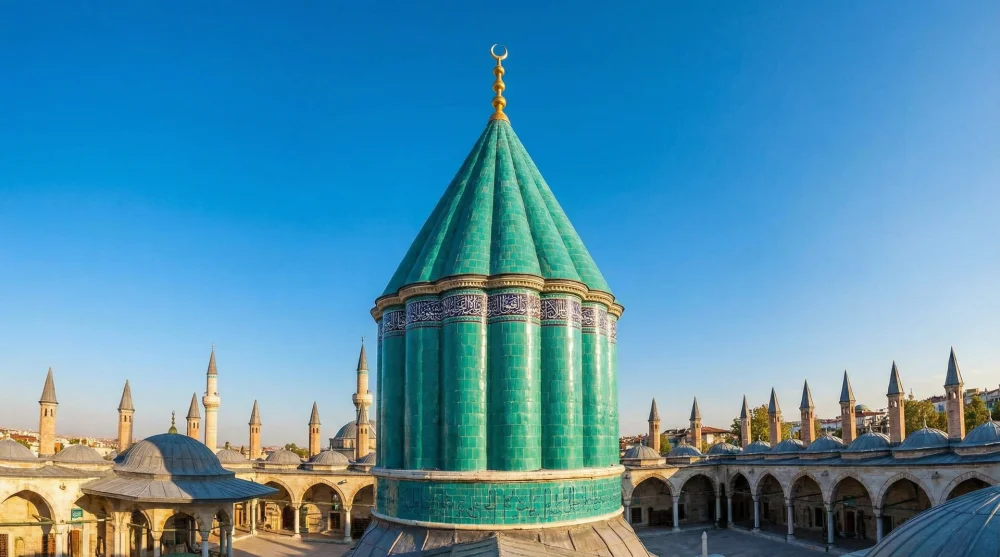
The biggest mistake visitors make at Mevlana Museum is arriving after the morning rush, when tour buses have already filled the courtyards and the reverent silence beneath the famous green dome has given way to shuffling crowds. Show up right at opening time and you get the full weight of the space to yourself, along with a parking spot.
| Detail | Info |
|---|---|
| Admission | Free |
| Audio Guide | 90 TL |
| Opening Hours | 09:00 - 17:30 (Monday: 10:00 opening) |
| Ticket Desk Closes | 16:30 |
| Recommended Duration | 1.5 - 2 hours |
| Parking | Available directly adjacent to the museum |
| Accessibility | Fully wheelchair accessible |
Who Was Mevlana?
Jalal ad-Din Muhammad Rumi, known in Turkey as Mevlana ("our master"), was born in 1207 in Balkh, in present-day Afghanistan. His family fled westward during the Mongol invasions, eventually settling in Konya under the patronage of the Seljuk Sultanate of Rum. His father, Baha ud-Din Walad, known as Sultanü'l-Ulema, was a respected Islamic scholar, and Mevlana followed in his footsteps until a life-changing encounter transformed him entirely.
In 1244, Mevlana met the wandering dervish Shams-i Tabrizi in Konya. The two formed an intense spiritual bond that Mevlana later described as the experience of divine love in human form. Shams disappeared under mysterious circumstances in 1248, and Mevlana channeled his grief into some of the most celebrated poetry in the Persian literary tradition.
His masterwork, the Masnavi-yi Ma'navi (Spiritual Couplets), comprises six books of roughly 25,000 verses, dictated to his devoted disciple Husam al-Din Chalabi over more than a decade.
Mevlana died on December 17, 1273. He called his death the Sheb-i Arus, the Wedding Night, meaning reunion with the divine. His followers did not mourn; they celebrated.
2026 Admission, Hours and Tickets
Entry to Mevlana Museum is free. There is no ticket queue at the gate. If you want to explore the historical details at your own pace, audio guide devices are available for rental at 90 TL at the entrance. The museum's Bluetooth system is not compatible with personal wireless earphones, so use the device they provide.
The museum opens at 09:00 daily; on Mondays the ticket desk opens at 10:00. Closing time is 17:30, with the ticket desk stopping operations at 16:30. In winter especially, avoid leaving your visit to the afternoon.
Getting to Mevlana Museum
The museum is in the Aziziye neighborhood, in the heart of Karatay district, Konya. Address: Aziziye Mahallesi, Müze Alanı Caddesi No:1, Karatay/Konya.
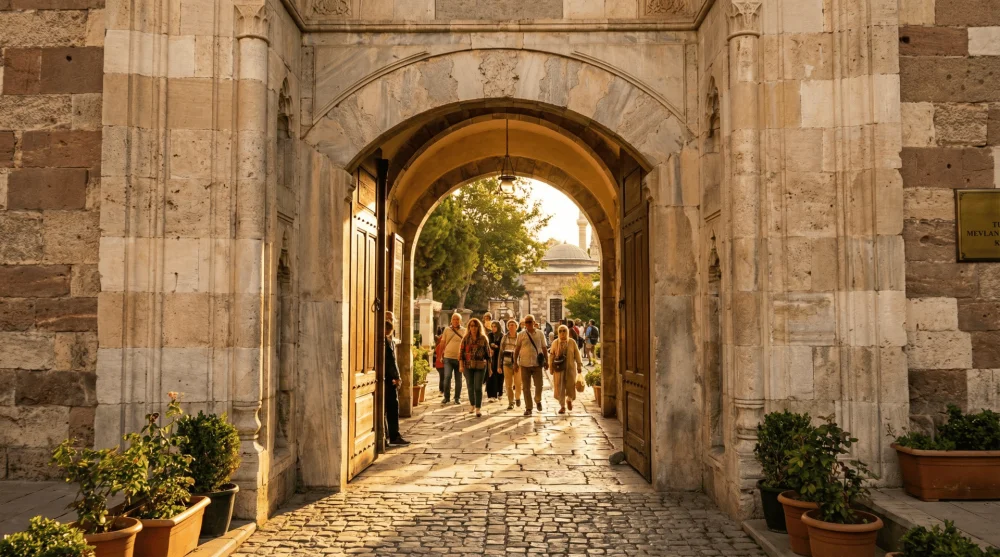
From anywhere in the city center, take the modern electric tram heading toward Alaaddin Hill and get off at the museum stop. As you step off, the turquoise dome is right in front of you. If you are driving, use the large car park immediately adjacent to the museum. It fills up completely around midday, which is another reason to arrive early.
The Sheb-i Arus Commemoration (December 17)
Every December 17, the anniversary of Mevlana's death, Konya hosts the Sheb-i Arus (Wedding Night) ceremonies. The city transforms for the occasion. Hotels book up months in advance, streets fill with visitors from across Turkey and abroad, and the program spans several days of Sema performances, Masnavi readings, and scholarly gatherings.
If you plan to visit during this period, make reservations two to three months ahead. Accommodation prices increase significantly and central hotels sell out entirely. The atmosphere is extraordinary, but so is the crowd.
What to See Inside the Museum
The museum complex evolved from the dervish lodge (tekke) that grew around Mevlana's tomb after his death. The various sections you walk through today were added and expanded over several centuries, primarily under Ottoman patronage.
The Courtyard and the Şadırvan Fountain
You enter through a large courtyard lined with the cells of Mevlevi dervishes. The şadırvan (ablution fountain) at the center was commissioned by Yavuz Sultan Selim in the 16th century. It served as the ritual washing point before prayer and meditation, a symbol of spiritual purification before entering the sacred spaces. Take a few minutes here before moving deeper into the complex.
The Tilawet Room
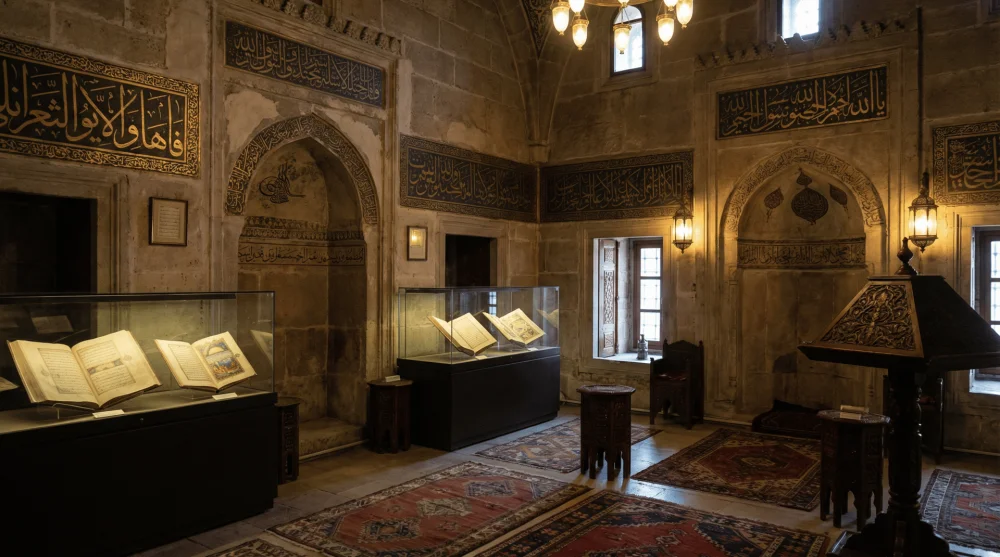
Just before the main tomb chamber, you pass through the Tilawet Odası, the Quran recitation room. This was where dervishes gathered to read and memorize sacred scripture. The room contains some of the finest examples of Ottoman calligraphic art in the complex, worth a slower look before continuing.
Kubbe-i Hadra (The Green Dome) and the Tombs
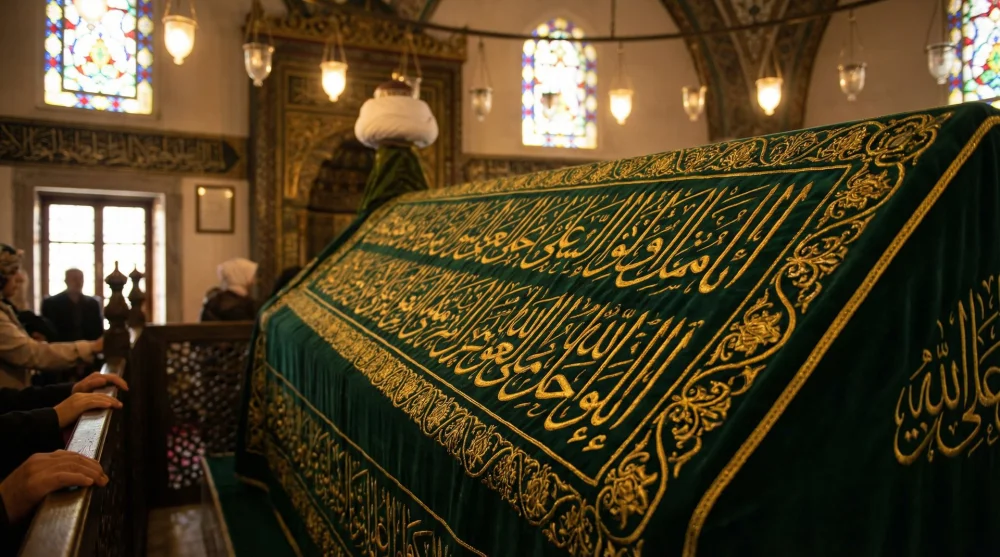
The interior beneath the dome is dim and deliberately imposing. This is the spiritual center of the entire complex. Mevlana's tomb is here, draped in cloth embroidered with Quranic verses, topped with a large turban symbolizing his spiritual rank. His son Sultan Walad lies nearby.
The tomb of his father, Baha ud-Din Walad, stands upright rather than lying flat. The popular explanation is that the father rose out of respect for his illustrious son. The actual reason is more technical: this is a Seljuk wooden sarcophagus form in which the headboard section is built taller, a characteristic of the period's carpentry tradition. Both explanations are worth knowing before your visit.
A silver-framed gate, the Gümüş Kapı (Silver Door), marks the threshold into this section. Slow down here.
Blue overshoes are provided at the entrance to the inner hall. Put them on over your shoes before stepping inside.
The Semahane (Sema Hall)
The Semahane was the hall where Sema, the whirling ritual, was performed. It no longer functions as an active ritual space; it is now one of the richest sections of the museum.
On display here are Mevlevi garments and ceremonial objects, including the ney (reed flute), the kudüm (small kettledrum), and the rebab (a bowed string instrument), the three instruments central to Mevlevi music. The hall also houses one of the oldest known manuscripts of the Masnavi in the world, as well as other works written on gazelle skin. The Beard of the Prophet (Sakal-ı Şerif) is kept here in an ornate reliquary.
The Matbah-ı Şerif (Sacred Kitchen)
The kitchen was not simply a place to prepare food. In Mevlevi tradition, it was the primary space for training new initiates. Novice dervishes, called nev-niyaz, spent their first 1,001 days of training in service here, learning discipline, humility, and presence through the most mundane tasks. The senior dervish overseeing them occupied the Saka Postu, a specific seat of authority within the kitchen.
The philosophy guiding this process is captured in Mevlana's three-word statement: "Hamdım, piştim, yandım" ("I was raw, I was cooked, I was burned"), a metaphor for the three stages of spiritual development.
Wax figures re-create daily life in the tekke. The doorways into the individual cells are very low; mind your head.
The Sakal-ı Şerif and Manuscript Collection
One of the world's smallest handwritten Qurans is on display in this section. The manuscript cases hold extraordinary examples of miniature calligraphy. If you want to spend time studying the details, step to the side, the flow of visitors through this area is constant.
Rules and Practical Notes
The museum is both a historic monument and an active site of reverence. Dress accordingly. Shoulders and knees should be covered. Women are expected to cover their heads in the main tomb section; free scarves are available at the entrance if needed.
Flash photography is prohibited inside. Switch your phone to night mode in the dim interior and confirm the flash is off before shooting.
The rose garden in the courtyard is a good place to decompress after the intensity of the interior. Benches are available and the atmosphere is calm. Allow an extra 15 to 20 minutes for it.
If you want to see an actual Sema performance during your visit to Konya, tickets for the Saturday evening ceremony at the cultural center next to the museum (starting around 18:30) should be purchased in advance. During Sheb-i Arus week, schedules vary.
For another historically layered Istanbul experience before or after your Konya trip, Besiktas Square covers one of Istanbul's most active waterfront districts, with its own cluster of monuments and museums within walking distance.