Arriving at the Mausoleum of Emperor Ferdinand II on a winter Monday guarantees locked doors and a completely missed opportunity to see Graz's finest Baroque interior. Timing your visit according to the strict, seasonal schedule is the absolute key to standing beneath Johann Bernhard Fischer von Erlach's intricate stucco ceilings without facing disappointment.
- Entrance to the main floor: free
- Bell tower access: €6 (cash only)
- Season 2026: April to October (Tuesday to Sunday, 9:00 to 17:00), winter visits by prior arrangement
- Duration: 30 to 45 minutes
- Location: Bürgergasse 1, next to Graz Cathedral
The Architecture: An Italian Masterpiece in Austria
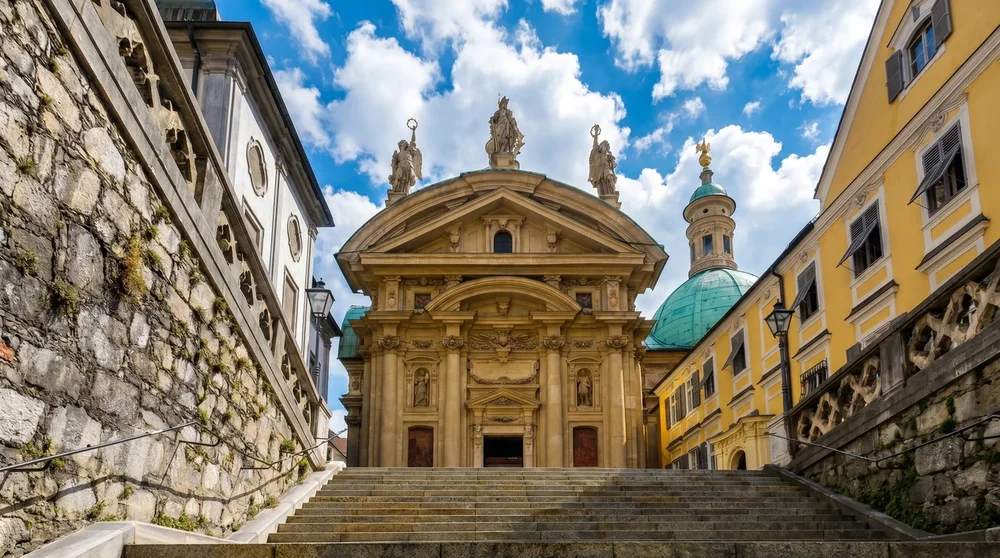
Emperor Ferdinand II commissioned Giovanni Pietro de Pomis to design this resting place long before his death. The structure blends the transition from Renaissance to early Baroque perfectly. The exterior is entirely striking, the iconic turquoise domes bright against the Graz skyline. This specific Italian influence brings a strong Mediterranean feeling right into the heart of Austria.
Kepler's Ellipse and the Floor Plan
The oval shape of the dome is not a random artistic choice. The famous astronomer Johannes Kepler had recently calculated the exact shape of an ellipse during his time in Graz. The architects implemented this groundbreaking mathematical discovery directly into the floor plan of the mausoleum. This makes the building a physical representation of 17th-century scientific progress, and the space is incredibly balanced, the geometric precision visible from every corner. It also holds the distinction of being the first building outside Italy to feature an oval dome of this kind.
The Sarcophagus of Red Marble
Do not look for the emperor's grand tomb on the main floor. Step towards the altar and look down through the circular opening in the floor. Below lies the massive red marble sarcophagus belonging to Ferdinand's parents. The crypt is perfectly illuminated, the heavy stone reflecting a deep crimson color. Interestingly, only his mother Maria of Bavaria rests inside it, while Ferdinand II himself occupies a modest wall niche marked by a simple tablet.
Inside the Mausoleum: What Not to Miss
The interior decorations are the earliest documented works of the legendary Austrian architect Johann Bernhard Fischer von Erlach. The transition from the somewhat sober exterior walls to the richly decorated inside is immediate. A convex mirror near the entrance lets you study the ceiling frescoes without straining your neck, a small but very practical touch that many visitors miss.
The Heart Crypt (Herzgruft)
The Habsburg family practiced separate burials for different body parts. A dedicated heart crypt holds the hearts of Ferdinand II and several other family members in silver urns. The atmosphere down here is deeply solemn, the historical weight undeniable. Pay close attention to the stucco putti and insignias on the walls. They represent the various lands ruled by the emperor.
Ceiling Frescoes by Steinpichler
Look straight up when standing under the main vault. The elaborate ceiling frescoes by Franz Steinpichler depict Emperor Leopold I as the glorious victor over the Ottomans. The colors are incredibly vivid, the historical propaganda woven seamlessly into religious art. These paintings framed by rich stucco work create a visual depth that draws the eye upward constantly.
Practical Info for Your Visit
Visiting this section of the Stadtkrone requires a bit of spatial awareness. The entrance feels somewhat hidden next to the much larger church buildings, and arriving during the midday break (12:00 to 13:30) means waiting outside.
Entrance Fees and Opening Hours
You can explore the main chapel and look down into the crypt entirely for free. If you want to climb the narrow, spiraling steps of the bell tower for a panoramic view of the city, you need to pay €6 in cash. Bring exact change, as the front desk often runs out. During the high season (April to October) the mausoleum is open Tuesday through Sunday from 9:00 to 17:00. Winter access is only available through prior arrangement by contacting the Diocesan Museum at +43 316 8041-890.
How to Get There
Walk up the Burggasse away from the main square. Pass the old university buildings and turn right into the narrow courtyard. Just like the Vilnius Cathedral complex in Lithuania, where the bell tower entrance hides in plain sight, finding the right door here rewards the attentive visitor. The small side door of the mausoleum is your entry point. Head inside and let your eyes adjust to the darker, incense-scented air.
Nearby Landmarks to Complete Your Tour
Do not leave the area without seeing the rest of the Graz City Crown. The Cathedral shares the exact same plaza and offers a Gothic contrast to the Baroque mausoleum. Walk another two minutes up the hill to find the famous double spiral staircase inside the Grazer Burg. Combining these three locations gives you the complete historical picture of imperial Graz without spending a single cent.