Finding the Cape Rockjumper often turns into a frustrating game of hide-and-seek against a backdrop of harsh sunlight and endless fynbos. Rooiels is widely regarded as the most reliable site on earth for this fynbos-endemic species, but pinpointing its exact territory requires knowing which specific boulder fields to scan and how to read the micro-habitat before the midday heat pushes them into hiding.
- Location: Porter Road, Rooiels (via the R44 Clarence Drive)
- GPS: -34.3076, 18.8175 (parking at the boom gate)
- Target Species: Cape Rockjumper (Chaetops frenatus)
- Entrance Fee: Free (public-access dirt road)
- Parking: At the boom gate (do not block access)
- Terrain: Flat dirt road, transitioning to steep, rocky slopes
- Ideal Conditions: Early morning, strictly windless days
How to Get to the Porter Road Birding Site
Navigating to the exact spot is straightforward if you know where to turn. Take the incredibly scenic R44 (Clarence Drive) from Gordon's Bay towards Kleinmond. Once you reach the small coastal village of Rooiels, take the second turn-off into town onto Porter Road.
Drive all the way to the end of this road until you hit a boom gate. This is your parking spot, marked by the GPS coordinates above. Leave your car outside the gate, making absolutely sure you aren't blocking access for residents or emergency vehicles.
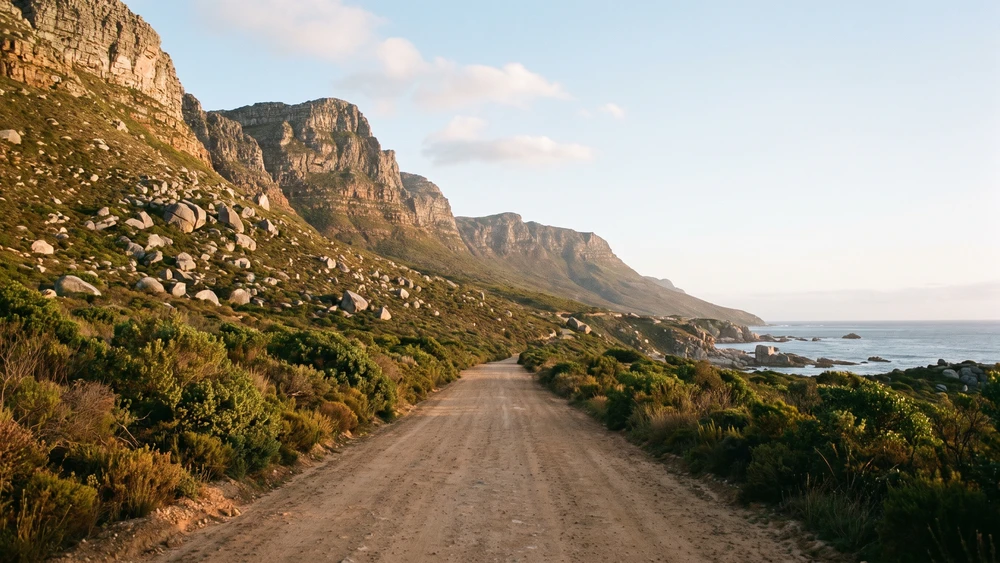
From here, the birding is entirely on foot. You walk down a wide, closed dirt road devoid of vehicle traffic, allowing you to focus entirely on the mountain slopes to your left.
Best Time to Visit
Wind is your biggest enemy here. Even a moderate breeze forces the birds deep into the low, scrubby restio vegetation, dropping your chances of a sighting to near zero. Always check the local forecast and aim for a completely still morning.
Timing your visit for spring and early summer aligns with their breeding season. During these months, the males become highly territorial and frequently hop atop prominent rocks, fanning their long black tails in display.
Arrive at dawn. Cape Rockjumpers have notoriously low heat tolerance; once the sun starts baking the rocky slopes, they retreat into the shadows of overhangs to forage for insects and small lizards.
Expert Tips for Spotting the Cape Rockjumper
You don't need to scan the entire mountain. The prime habitat starts about 500 metres beyond the boom gate. Keep your eyes locked on the eastern (left) side of the road, where the steep, boulder-strewn slopes of False Hangklip meet the coastal fynbos.
Reading Their Habitat and Behavior
These birds are predominantly terrestrial specialists. They don't fly high or cover long distances in the air. Instead, look for a sudden, springy movement: they bounce rapidly from rock to rock, often taking a quick, gliding descent before dropping completely out of sight into the scrub.
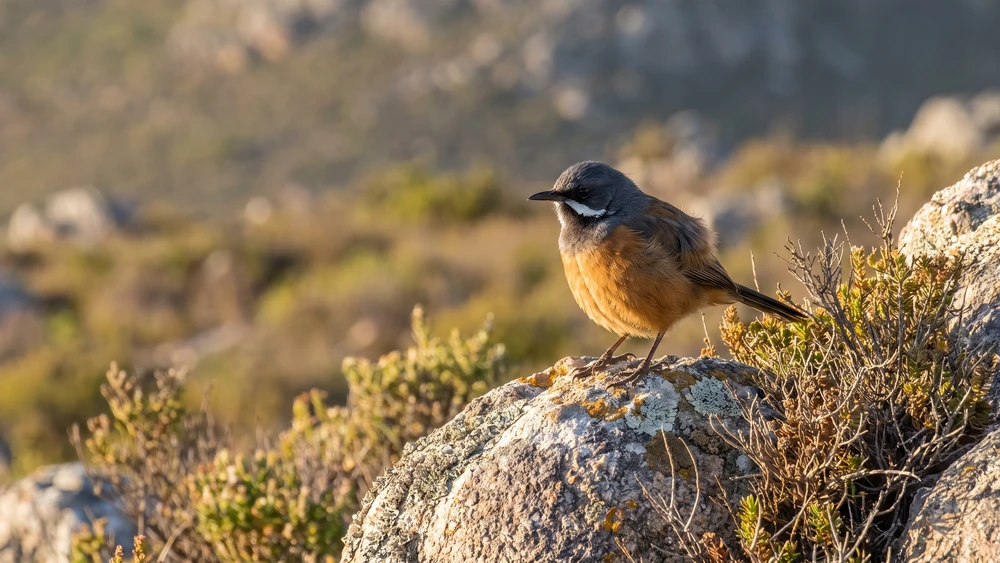
Patience is non-negotiable. Pick a section of large boulders, set up your binoculars or spotting scope, and wait. Listen closely for their distinct vocalization, a series of one to four piercing whistles or a rolling trill echoing off the rocks. Once you spot the male's striking dark grey head, white malar stripe, and vibrant rufous underparts, tracking their movement becomes much easier.
Other Endemic Fynbos Species in the Area
The Kogelberg Biosphere Reserve surrounding Rooiels is a goldmine for Cape endemics. While the Rockjumper is the main prize, the surrounding vegetation supports a dense concentration of highly sought-after species.
- Ground Woodpecker: Often found in the exact same rocky habitat as the Rockjumper.
- Cape Sugarbird: Scan the tops of flowering proteas. Their exceptionally long tails make them easy to identify against the skyline.
- Orange-breasted Sunbird: Look for bright flashes of orange and metallic green flitting rapidly between erica bushes.
- Victorin's Warbler: A notorious skulker. You will likely hear its descending trill from the wetter, denser thickets before you see it.
- Cape Siskin: Frequently seen in small flocks moving through the scrub.
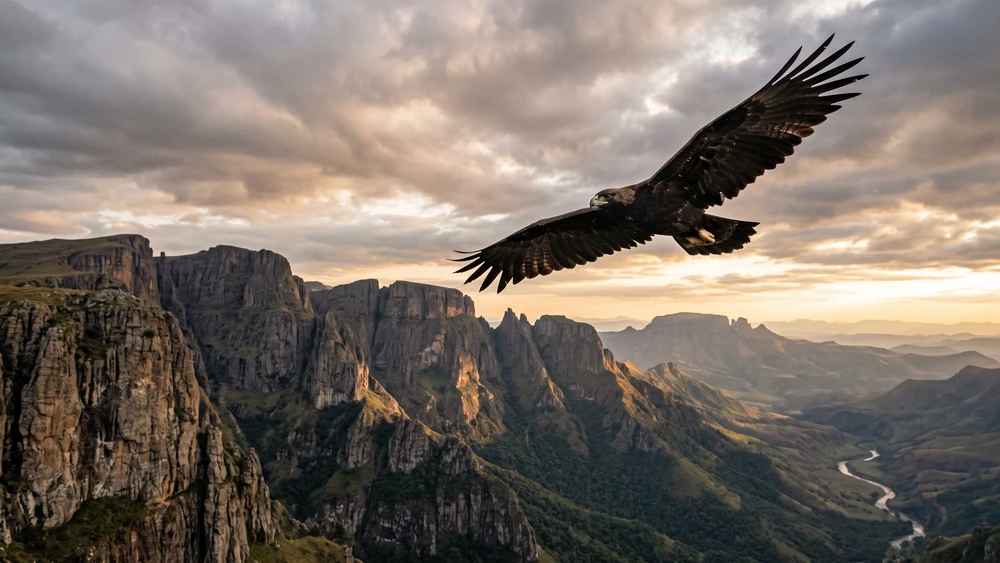
Don't forget to look up. The massive cliffs above the dirt road are established breeding grounds for Verreaux's Eagles. It is quite common to see these massive black raptors patrolling the thermals, sometimes accompanied by a juvenile or being actively harassed by smaller, fiercely territorial birds.
Essential Birding Etiquette on Private Property
The Porter Road site borders private property and forms part of a highly sensitive ecological zone. The dirt road provides a perfect vantage point, so there is rarely a need to stray deep into the pristine fynbos.
Walking off-trail damages the exact low-scrub vegetation these ground-nesting birds rely on for survival and temperature regulation. Keep your voice low, avoid using playback calls, which can cause unnecessary stress during breeding season, and let the natural behavior of the birds dictate the pace of your morning.