Driving in the United States feels straightforward until your first four-way stop or a school bus pulls over in front of you. American road rules carry several hard-to-guess exceptions that European and international drivers regularly get wrong, and some of them carry serious fines or even police stops. If you are planning a road trip or renting a car for a US vacation, these are the rules you actually need to know before you turn the ignition.
- Driving side: right
- Speed measurement: miles per hour (mph)
- Drive with your foreign license (IDP recommended as backup)
- Minimum age for rental cars: 25 at most companies (under-25 surcharge applies)
- Seatbelts: mandatory for all passengers in all states
- BAC limit: 0.08% (zero tolerance in some states for under-21 drivers)
Can You Drive in the USA with a Foreign License?
You can legally drive with your home country license for tourist visits across the United States. Most states allow this for up to 12 months. Bring an International Driving Permit (IDP) as a backup to avoid translation issues , rental companies and highway patrol officers prefer seeing both documents together, especially if your license uses a non-Latin script.
Getting an IDP before you leave home is straightforward. The American Automobile Association (AAA) issues them to foreign nationals visiting the US, and most national automobile clubs in your home country can issue one as well.
The Biggest Differences: US Traffic Rules You Must Know
The Right on Red Rule and Its NYC Exception
Unless a sign explicitly forbids it, you can turn right at a red light after coming to a complete stop. Yield to pedestrians and cross-traffic first before making your move. Look carefully for cyclists approaching in your blind spot , this is a common miss for international drivers.
New York City strictly bans this practice. Within the five boroughs, you must wait for the solid green light unless a sign specifically permits the turn. The same ban applies to a few other cities with posted signs.
Four-Way Stops: Who Actually Goes First?
Intersections without traffic lights feature stop signs on all four corners. The rule: whoever arrives and stops first, goes first. If two cars arrive simultaneously, the car on the right has the right of way. If three or four cars arrive at once, it gets messier , eye contact, a patient wave, and a willingness to yield solve it every time. Americans are generally cooperative at these intersections.
School Buses: When Do You Need to Stop?
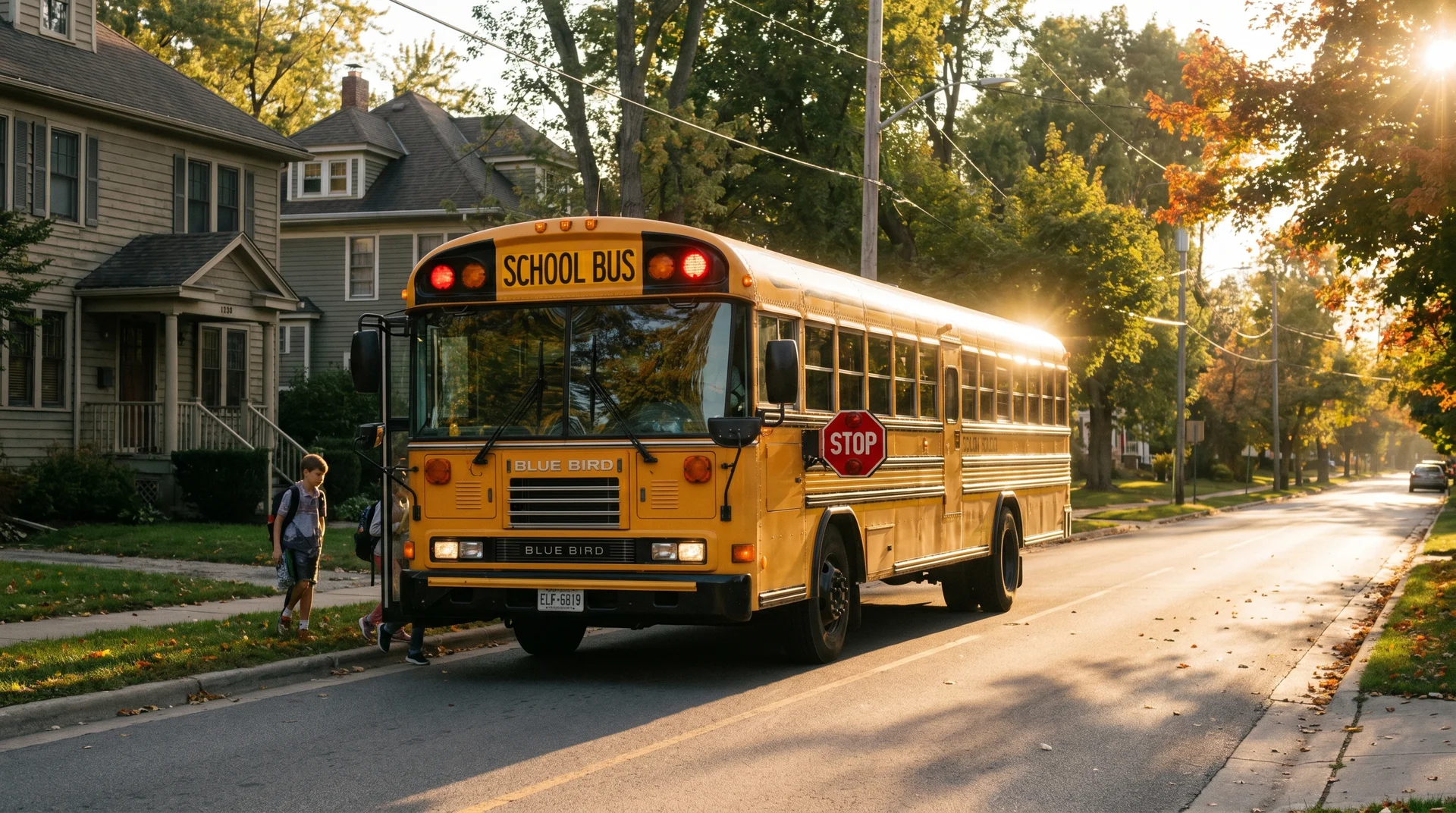
Passing a yellow school bus with flashing red lights is a severe traffic offense enforced in all 50 states. Traffic in both directions must halt completely, regardless of which side of the road you are on. The only exception is on divided highways where a physical concrete median separates your lane from the bus. Wait patiently until the bus turns off its red lights and retracts its stop sign arm before moving again. Fines can exceed $1,000 and violations go on your driving record.

Move Over Law: Emergency Vehicles on the Shoulder
Every US state has a Move Over law. When you see a police car, ambulance, fire truck, or tow truck stopped on the shoulder with lights flashing, you are legally required to move one lane away from them. If lane change is not possible due to traffic, slow down significantly , usually to at least 20 mph below the posted limit. Violations carry heavy fines.
Understanding US Speed Limits and Cameras
Speed limits are posted in miles per hour. Highway limits vary significantly: interstate highways typically run 65-80 mph, urban interstates drop to 55-65 mph, residential streets sit at 25-35 mph, and school zones drop as low as 15-20 mph when children are present.
Speed cameras are relatively rare compared to Europe, but highway patrol officers frequently hide behind overpasses or trees with radar guns. Stick close to the flow of traffic but never exceed the posted limit. Radar detectors are legal in most states but banned in Virginia and Washington D.C.
Seatbelts and Child Safety Seats
Seatbelt laws apply in all 50 states. Front seat belts are universally required, and most states require rear seat passengers to buckle up as well. Children under a certain age and weight must use an approved car seat or booster seat , the exact rules vary by state, but most require car seats until age 8 and booster seats until around 4 feet 9 inches tall.
Rental car companies do not automatically provide child seats. You need to book them in advance, and the daily fee can add up quickly on longer trips.
Mobile Phone Laws
Using a handheld phone while driving is illegal in most US states. Many states have primary enforcement, meaning police can pull you over solely for holding your phone , no other violation needed. Hands-free calls via Bluetooth are generally permitted, but texting is banned essentially everywhere. California, New York, and Washington state are among the strictest enforcers.
DUI Laws: The 0.08% Limit
The legal blood alcohol content (BAC) limit in all US states is 0.08%. For drivers under 21, the limit is effectively zero in most states. Police conduct roadside checkpoints, particularly on holiday weekends, and refusal to take a breathalyzer test typically results in automatic license suspension. A DUI conviction in the US can complicate future visa applications and re-entry.
Navigating Toll Roads, E-ZPass, and Rental Cars
Cash toll booths are rapidly disappearing across American highways. Most toll roads now use electronic scanning systems such as E-ZPass (Northeast and Midwest), SunPass (Florida), and FasTrak (California). Rental companies offer transponder devices but often charge hefty daily administrative fees on top of the actual toll.
The cheapest option is to pay tolls online directly through the state transportation website within a few days of your trip , most states send a bill to the license plate registered address, and foreign plates often slip through, but it is not guaranteed. If you are renting a car and planning to use toll roads extensively in Florida or the Northeast, pricing out the rental company's transponder program versus paying individually is worth doing in advance.
Highway Driving: The Keep Right Rule and Carpool Lanes
The left lane is strictly for passing. Lingering in the left lane blocks traffic flow, frustrates local drivers, and is ticketable in many states. Move right once you have completed your pass.
Major highways also feature High Occupancy Vehicle (HOV) lanes marked with a painted diamond symbol on the asphalt. These carpool lanes require at least two or three occupants (check the posted signage , it varies). Some HOV lanes are only restricted during peak hours. Motorcycles and certain electric vehicles often qualify for solo use. Getting caught alone in an HOV lane runs $100-$500 depending on the state.

Dealing with US Police: What to Do If Pulled Over
Seeing flashing police lights behind you means pull over safely to the right shoulder immediately. Stay inside the vehicle at all times. Turn off the engine, roll down your window, and keep both hands visibly resting on the steering wheel. Wait for the officer to approach.
Do not reach into the glovebox for your documents until the officer explicitly asks you to, and always verbally announce what you are about to do before moving your hands. American police stops follow a specific protocol, and moving unexpectedly can escalate the situation unnecessarily.
As a foreign visitor, calmly mention that you are a tourist , officers generally understand that international drivers may be unfamiliar with local procedures. For a smooth stop experience at a Houston Museum of Natural Science or a coastal stop near Glass Beach in Fort Bragg, California, keeping your license and IDP accessible in the center console (not the glovebox) saves time and reduces awkward movements.
Gas Stations: Why You Cannot Pump Your Own Gas in New Jersey
Self-service is the standard procedure across the country. You insert your credit card, select the fuel grade, and pump the gas yourself. Most stations accept credit cards at the pump without interaction.
New Jersey is the famous exception. State law forbids self-service, so a professional attendant will always approach your window to pump the gas for you. You stay in the car, tell them the grade and whether you want a full tank, and pay when they are done. Oregon also had a similar law but removed the full-service requirement in most counties in recent years , though rural Oregon stations may still offer attendant service.