Expecting to find an intact luxury liner resting peacefully at the bottom of the Atlantic is the most common misconception among deep-sea enthusiasts. The crushing pressure and aggressive biological decay are actively dissolving the vessel, making every new sonar scan a final snapshot of a rapidly vanishing structure.
- Location Depth: 12,500 feet (3,800 meters)
- Environmental Pressure: 5,850 psi
- Ocean Ecosystem: Bathyal Zone (Midnight Zone)
- Primary Structural Threat: Halomonas titanicae bacteria
How Deep is the Titanic Wreckage? (Inside the Midnight Zone)
Descending to the ocean floor takes you into an environment entirely devoid of sunlight. The surroundings are completely pitch black, the water temperature sits barely above freezing. You are entering the Bathyal zone, an isolated ecosystem where the sheer weight of the ocean above creates a pressure equivalent to dozens of heavy vehicles resting on your chest.
Navigating this space requires advanced submersibles equipped with incredibly powerful lighting arrays. The wreck does not sit in one piece. The bow and stern lie far apart, surrounded by a vast debris field spanning 15 square miles. Items scattered across the ocean floor remain hidden in the darkness until a focused beam of light suddenly reveals a boiler or a piece of the hull. The wreck sits approximately 400 nautical miles off the coast of Newfoundland, Canada, roughly 370 miles from St. John's.
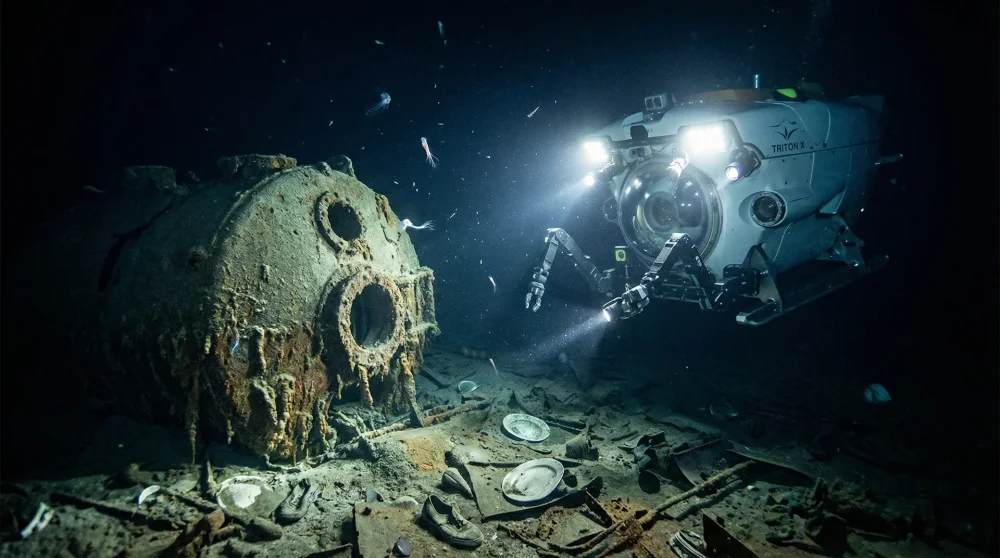
The Current State of the Ship: What Recent 3D Scans Revealed
Modern exploration relies heavily on high-resolution digital scans to understand the full scale of the wreckage. In summer 2022, a six-week Magellan expedition deployed two remotely operated vehicles, nicknamed Romeo and Juliet, to create the first full-size digital twin of the wreck.
They captured 715,000 photographs, hours of 4K footage, and millions of laser measurements totalling 16 terabytes of data. Before these digital twins existed, explorers could only view tiny sections of the ship illuminated by small submersible lights. Now, photorealistic models allow scientists to observe the massive structural changes happening across the entire hull.
The ship is undeniably collapsing.
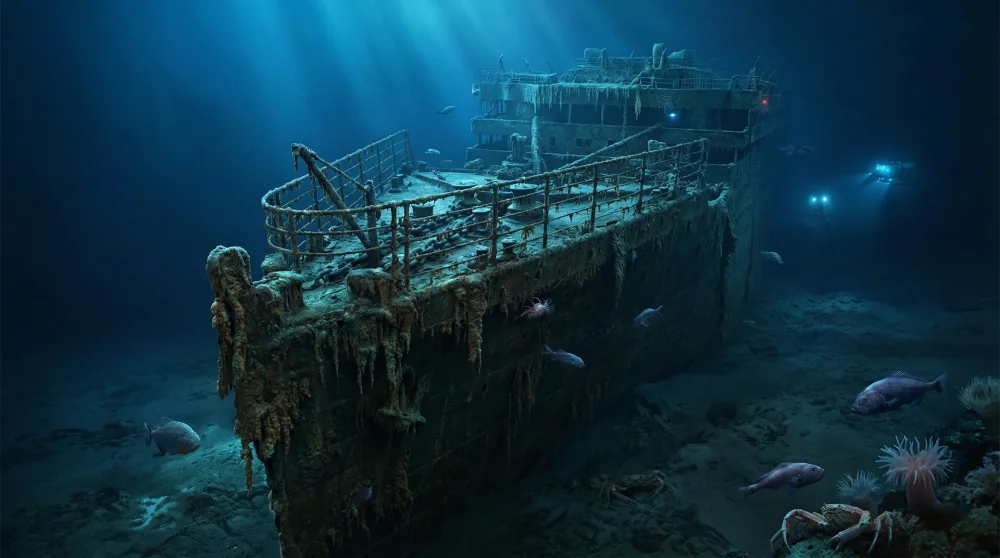
What the Digital Twin Revealed
Reassembling the hull pieces digitally confirmed the Titanic did not split cleanly in half. The ship was violently torn apart, ripping through first-class cabins as it broke. Researchers also discovered an open steam valve near the engine room, indicating crew members remained at their posts keeping the electricity running until the very end. Several iconic landmarks have already vanished: the 100-foot forward mast, the crow's nest, and the poop deck gymnasium have all collapsed.
The Loss of Captain Smith's Quarters
The starboard side of the officer quarters was once a prime focal point for underwater observation. Today, that entire deck section is collapsing inward. The famous bathtub belonging to the captain is entirely gone, swallowed by the collapsing staterooms. The structural integrity of the upper decks fails a little more with every passing ocean current.
Halomonas Titanicae: The Bacteria Eating the Ship Alive
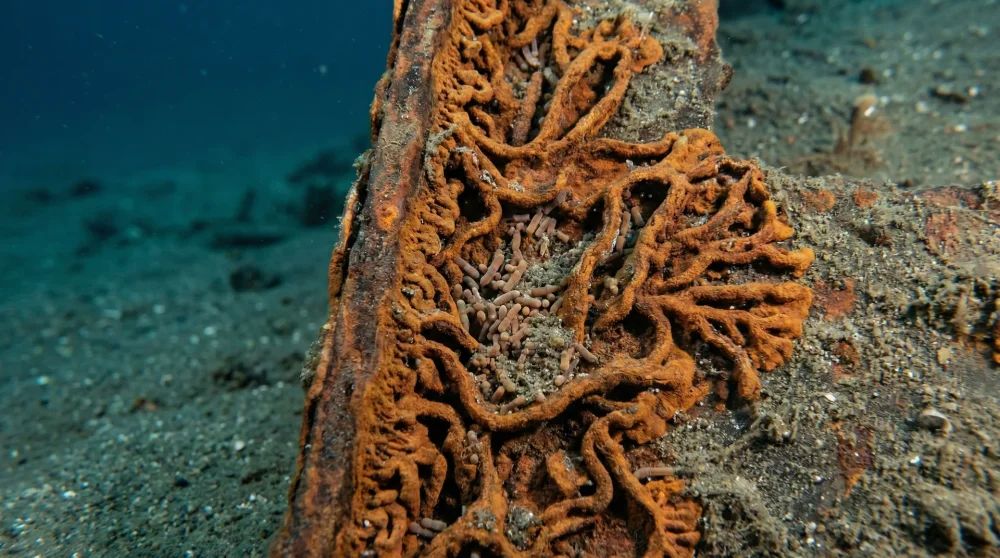
The deterioration is not simply a matter of saltwater rust. A unique, metal-eating microbe thrives on the sunken steel. This bacteria, isolated and identified in 2010 from samples collected at the wreck site, forms massive, rust-colored structures resembling icicles that blanket the entire wreck.
These organic formations, known as rusticles, slowly extract the iron from the ship, giving the hull an eerie, melting appearance. Over time, rusticles dissolve into fine powder that deep-sea currents sweep away entirely. You are watching a natural biological process consume a man-made marvel.
When Will the Titanic Completely Disappear?
The ongoing decay is an irreversible reality. Henrietta Mann, one of the researchers who first isolated Halomonas titanicae, has estimated that microbial activity could bring about the total deterioration of the wreck by around 2030. The steel frame is losing its mass at a highly accelerated rate, with the most recognizable bow section expected to flatten into the ocean floor within years, not decades. Eventually, nothing will remain except a massive rust stain marking the final location of the famous vessel.
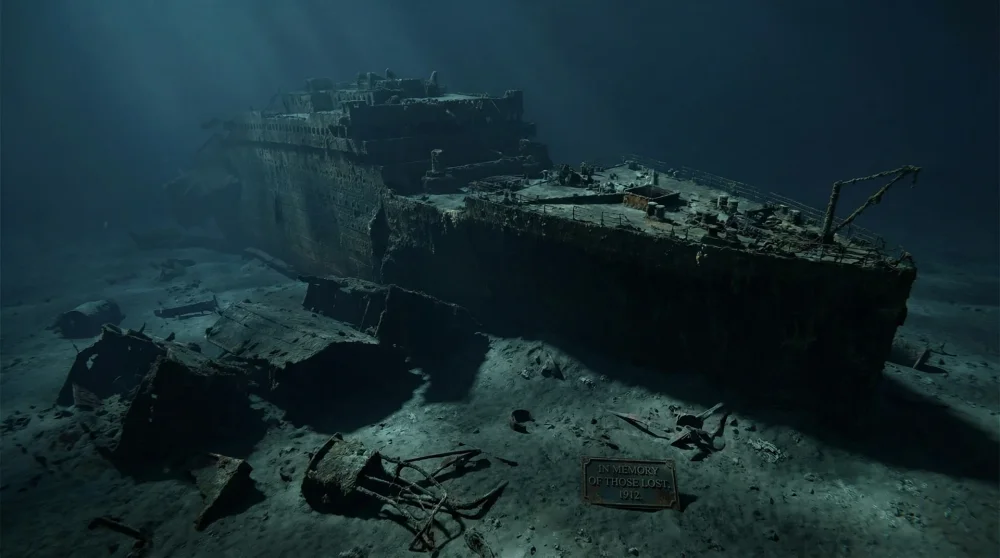
This urgency is precisely why the 2022 Magellan digital twin project carries such significance. The wreck is now permanently preserved in digital form even as the physical structure erodes. A National Geographic documentary covering the project, titled Titanic: The Digital Resurrection, documents the full findings.
Can You Visit the Titanic Wreck? (Exploration vs. Preservation)
Reaching the site requires highly specialized, deep-diving submersibles and significant logistical preparation. Before June 2023, OceanGate Expeditions offered civilian berths on Titanic dives for $250,000 per person, departing from St. John's, Newfoundland. The eight-day expeditions included one full dive to the wreck, accommodations, meals, and equipment. In June 2023, OceanGate's Titan submersible imploded during a descent, killing all five people on board. The company subsequently suspended all commercial operations.
As of 2026, no commercial operator offers civilian access to the Titanic site. Research missions by universities and oceanographic institutions continue on a strictly scientific basis.
The area serves as a solemn maritime memorial for the lives lost during the sinking. Current exploration missions operate on a look-but-do-not-touch basis to respect the site and protect its fragile state. The interior of the ship is heavily flooded, deeply silted, and incredibly dangerous to approach closely without causing further damage to the rotting metal. You must treat the wreckage as both a scientific laboratory and a final resting place.