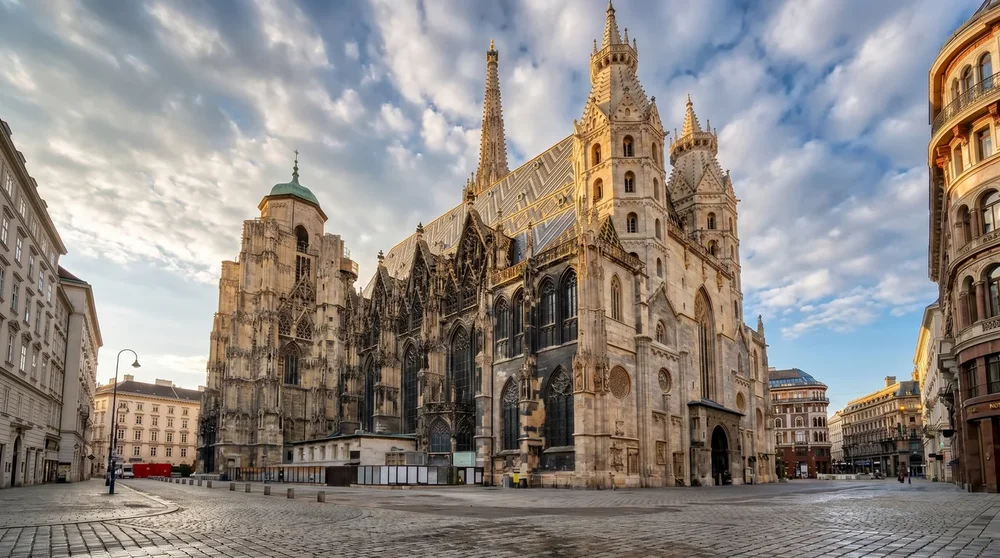
St. Stephen's Cathedral sits at the dead center of Vienna, both literally and historically. Every distance marker in the city measures from Stephansplatz. Knowing which ticket to buy before you join the queue saves you from a common trap: paying for access you will not actually use.
- Free zone: the back section behind the iron gate (entrance only)
- Interior ticket: €8 per adult, €3 per child
- North Tower (elevator): €8 per adult
- South Tower (343 steps, no elevator): €8 per adult
- Catacombs guided tour: €7 per adult
- All-Inclusive Bundle: €29 (covers interior, both towers, catacombs, Dom Museum + audio guide)
- Payment: cash only at the ticket desk
Free Area vs. Paid Access: What Do You Actually Get?
The moment you step inside, a massive wrought-iron gate blocks access to the main nave. The free zone only allows you to stand at the back of the church. The view from here is distant, the details of the High Altar completely obscured. To walk down the aisles, approach the side chapels, and see the intricate stonework up close, you need the basic interior ticket for €8. Buy this specific ticket if you want to take photos without crowds in your frame.
One thing most visitors miss: the ticket desk accepts cash only. There are ATMs on Stephansplatz, but they fill up with tourists during peak hours. Withdraw cash before you arrive.
South Tower vs. North Tower: Which View Is Better?
Choosing between the two towers dictates your entire experience here. They offer completely different physical challenges and viewpoints.
The South Tower (343 Steps, No Elevator)
This is the highest point of the cathedral at 136 meters. There is no elevator. You must climb 343 narrow steps to reach the watchman room. The spiral staircase is tight, the air often stuffy during summer. If you have claustrophobia or bad knees, skip this entirely. The panoramic view of Vienna from the top is substantial, but you view it through small windows rather than an open platform. The entrance fee is €8.
The North Tower & The Pummerin Bell
The North Tower is only 68 meters high, but it offers a far more comfortable experience. An elevator takes you directly to the viewing platform. The platform is open-air, the breeze refreshing. You get a perfect, unobstructed view of the famous glazed tile roof featuring the double-headed eagle. This is the better choice in December: the Christmas market on Stephansplatz spreads out directly below you.
This tower also houses the Pummerin, Europe's second-largest free-swinging chimed church bell, cast from cannons captured after the Ottoman siege of Vienna in 1683. The ticket costs €8.
If you want to do both towers in a single visit, start with the South Tower while your legs are fresh, then take the elevator up the North Tower afterward.
Exploring the Vienna Catacombs
Below the cathedral lies a vast network of underground burial chambers holding the remains of over 11,000 people, including early Viennese citizens and members of the Habsburg dynasty. You cannot wander down here alone. Access is strictly limited to guided tours, which run every 30 minutes from 10:00 to 11:30 and again from 13:30 to 16:30.
The air is damp, the corridors poorly lit. The tour covers two sections: the older renovated chambers with Habsburg remains, and the ancient burial area where bones are still visible in the walls. One firm rule: no photography or video is permitted anywhere inside the catacombs. The guided tour costs €7.
The exit brings you outside near the South Tower entrance, which makes for a logical circuit if you plan to climb afterward.
Hidden Details: The O5 Symbol and Mozart's Wedding
Look closely at the stone wall to the right of the giant main gate. You will find the symbol O5 carved into the facade. This discreet marking belonged to the Austrian resistance movement against the Nazi regime during the Second World War. The letter O combined with the number 5, representing E, the fifth letter of the alphabet, spelled out "OE" for Oesterreich, a word the Nazis had banned.
Inside the cathedral, the history feels equally dense. Wolfgang Amadeus Mozart married Constanze Weber right here in 1781. His funeral was also held in St. Stephen's, though he was buried elsewhere. If you are exploring the great religious architecture of Europe, the gothic detailing here rivals what you would find at Vilnius Cathedral, where the crypts beneath hold a similarly layered history.
Visiting the Dom Museum Vienna
The Dom Museum, connected to the cathedral, holds the treasury of the Archdiocese of Vienna. The collection includes medieval relics, Habsburg vestments, and the famous Rudolf's Cross, one of the earliest Habsburg artifacts still in existence. The museum is included in the all-inclusive ticket. If you buy tickets individually, check current hours separately, as the museum sometimes keeps different visiting times from the cathedral towers.
Best Time to Visit & Dress Code
Arrive at 09:00 when the towers open. The morning light hits the intricate stained glass at its best, and the tourist groups have not yet formed. Afternoon visits guarantee long queues at the North Tower elevator, particularly between 11:00 and 15:00.
Since this is an active place of worship, a dress code applies. Shoulders and knees must be covered. Hats must be removed inside. These rules are enforced at the ticketed entry points, not just at the altar. Scarves or light layers work if you are visiting in summer.
The recommended visiting sequence if you want to cover everything: Cathedral interior first, then North Tower, then Catacombs, then South Tower. This keeps the physically demanding climb for last and lets you pace yourself.
How to Get to St. Stephen's Cathedral
Take the U1 or U3 metro line and exit at Stephansplatz. The escalator brings you directly to the base of the South Tower. The square itself is pedestrian-only with no car traffic, which makes the approach from any direction straightforward.
From the Charles Bridge in Prague, Vienna is a four-hour train journey, making it a natural next stop on a Central European itinerary. The direct Railjet service runs several times daily between Prague's main station and Vienna Hauptbahnhof, from where you can reach Stephansplatz in under 15 minutes by metro.