Arriving at the Old Town Square at exactly noon is the quickest way to get stuck behind hundreds of smartphones and miss the actual details of the oldest functioning astronomical clock. Securing a clear view of the complex mechanics and avoiding the massive ticket lines requires arriving before 9 AM or knowing exactly which skip-the-line options work best.
| Feature | Details |
|---|---|
| Show Times | Every hour on the hour, 9:00 AM to 11:00 PM |
| Basic Admission | 350 CZK (Tower and exhibition access) |
| Online Skip-the-Line | 450 CZK |
| Lift Surcharge | 100 CZK |
| Opening Hours | Mon-Sun 9:00 AM to 8:00 PM (Jan-Mar starts 10:00 AM) |
| Best Time for Photos | 8:00 AM |
Prague Astronomical Clock Show Times (Walk of the Apostles)
The mechanical show happens every hour on the hour, starting at 9 AM and ending at 11 PM. The entire sequence lasts roughly 45 seconds. Many visitors expect a massive theatrical spectacle and leave slightly underwhelmed. The true magic lies in the engineering. You are watching a machine built in 1410 perform its daily routine.

The sequence begins with the skeleton ringing a bell. Two small windows open above the astrolabe. Wooden figures of the twelve Apostles shuffle past the windows one by one. Finally, a golden rooster flaps its wings and crows, signaling the clock on the tower to chime the hour.
Where to Stand to Avoid the Crowds
The area directly beneath the tower packs tight about fifteen minutes before every hour. Pickpockets operate heavily during this exact window. Keep your hands on your belongings.
Do not stand directly under the clock. Move slightly back toward the cafes on the opposite side of the square. The angle from further back gives you a much better view of the upper windows and the Apostle figures. Arriving at 8:45 AM for the first show of the day guarantees a completely unobstructed view. The air is cool, the cobblestone square almost entirely silent.

Old Town Hall Tower Tickets 2026
You can easily admire the clock from the square for free. Going inside the Old Town Hall requires a ticket. Buying your pass at the ground floor ticket office often means waiting in long lines. Purchasing an online skip-the-line ticket for 450 CZK saves you a significant amount of time.
Basic admission costs 350 CZK at the door. This allows you to walk up the ramps to the 42-meter-high viewing gallery. If you want to use the modern glass elevator inside the medieval tower, you need to pay an extra 100 CZK.
Is the Tower Lift Worth the Admission Fee?
Climbing the ramps is perfectly manageable for most people, but the elevator offers a quick alternative if you are short on time. The panoramic view from the top is spectacular. You get a clear, 360-degree look at the red rooftops, the Tyn Church, and the distant Prague Castle.
During the winter holidays, this viewpoint becomes highly strategic. Looking down at the Christmas market layout from above offers a completely different perspective. You see the glowing stalls and the massive tree without fighting your way through the ground-level crowds.
How to Read the Prague Astronomical Clock (Simply Explained)
The clock does not just tell the current time. It tracks the movements of the sun and moon while displaying the zodiac. The astrolabe face processes four different time systems simultaneously.
Central European Time: Look for the sun hand pointing to the golden Roman numerals. This is the standard time we use today.
Old Czech Time: The outermost ring features golden Gothic numbers on a black background. This system counts 24 hours starting from sunset. The ring actually moves throughout the year to adjust for changing sunset times.
Babylonian Time: The curved golden lines in the blue area track unequal hours. An hour is longer in the summer and shorter in the winter because the time is measured strictly from sunrise to sunset. This is the only clock in the world still tracking Babylonian time.
Sidereal Time: A small golden star attached to the zodiac ring tracks the rotation of the Earth relative to the fixed stars.
What Do the Moving Figures Mean?
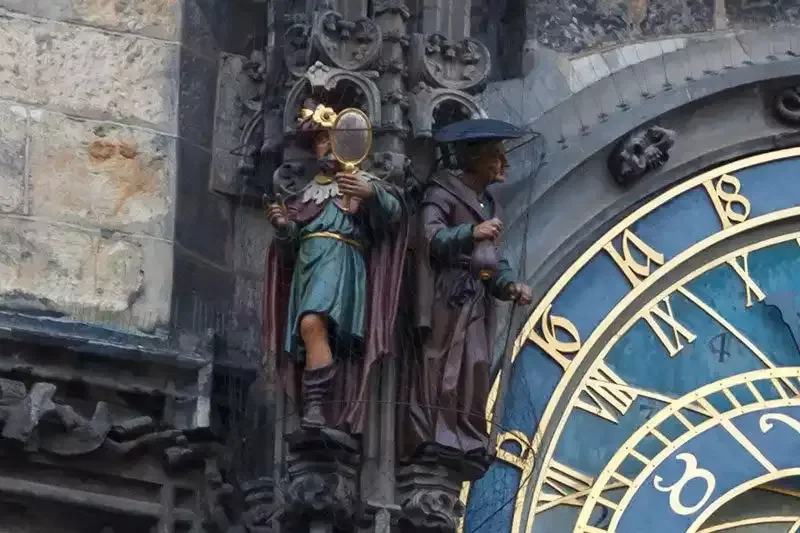
Four figures flank the main dial, representing the greatest fears of medieval society. The most famous is Death. The skeleton turns an hourglass and pulls a rope to ring the bell. Time always wins.
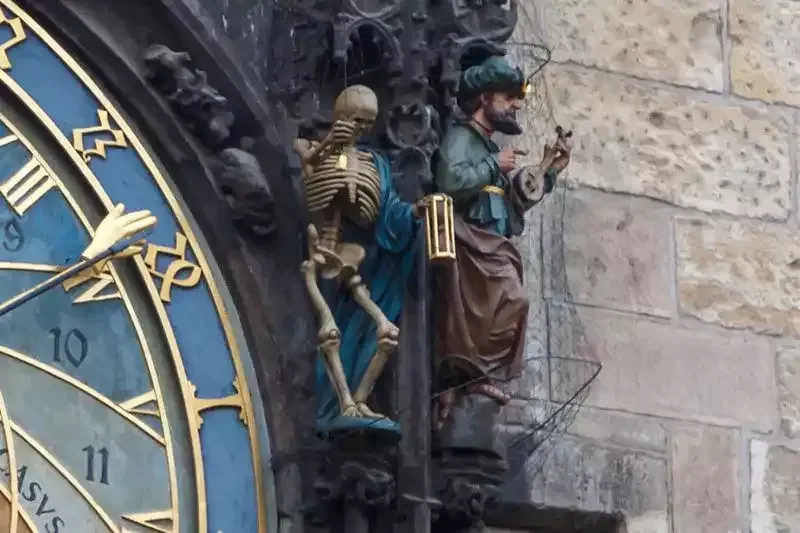
Next to him stands a figure holding a mirror. This represents Vanity. On the other side, a figure shakes a money pouch, symbolizing Greed. The final figure represents Lust. When the bell rings, all these figures shake their heads, refusing to accept their mortality.
The Dark History and the Curse of Master Hanus
Local legend claims a clockmaker named Master Hanus perfected the mechanism in the 15th century. According to the myth, Prague councilors deliberately blinded him with hot iron pokers so he could never build a more beautiful clock for another European city.
In retaliation, the blind clockmaker supposedly threw himself into the gears, jamming the machine and cursing it for decades. This is a dramatic 19th-century fabrication. Historical records prove a clockmaker named Mikulas of Kadan built the original mechanism. Multiple master craftsmen maintained the gears over the centuries, keeping their eyesight intact.
How to Get to the Old Town Square
The clock sits directly on the southern wall of the Old Town Hall. Navigating the narrow, winding streets of the Old Town can be tricky. Take the subway Line A (Green Line) and get off at the Staromestska station. Walk straight down Kaprova street for about five minutes. The square opens up right in front of you.

If you enjoy exploring medieval European landmarks with rich histories, the Vilnius Cathedral offers a similarly captivating mix of architecture and crypts. For a broader taste of Central European heritage, the Palace of the Grand Dukes of Lithuania and the Estonian History Museum make excellent companions to any trip itinerary.