Standing in a two-hour line for mainstream museums drains your energy before you even see a single painting, leaving you with zero patience for the actual artistic soul of the city. Stepping into the Opificio delle Pietre Dure saves your morning and reveals the intricate stone-cutting mastery that physically built the Medici family legacy.
- Adult Ticket: €6
- Reduced Ticket: €2 (EU citizens aged 18-25)
- Under 18: Free entry
- Average Duration: 1 to 1.5 hours
- Best Time: Early morning or right before closing
What is the Opificio delle Pietre Dure?
Grand Duke Ferdinando I de' Medici established this court laboratory in 1588. The primary goal was to train highly specialized artisans to decorate the immense family mausoleums with semi-precious stones. Understanding this intense background completely changes your perspective when you walk through the Basilica of San Lorenzo and Medici Chapels later in your trip.
The core technique developed here is Commesso Fiorentino. Artisans cut semi-precious stones and piece them together without any visible gaps. The resulting images look exactly like high-end oil paintings. The color variations come entirely from the natural shading of the stones.
What to See Inside the Museum (Floor by Floor)
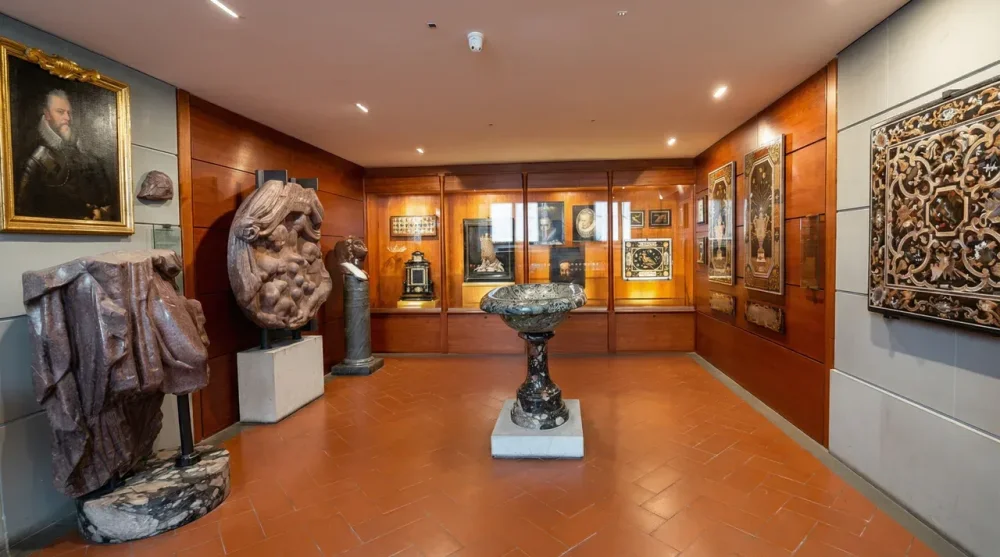
The museum layout follows a strict chronological and thematic order. The ground floor covers the historical evolution from the 16th to the 19th century. You immediately notice the dark, heavy porphyry sculptures favored by Cosimo I.
Moving forward, the Stone Flowers section dominates the space. Black marble backgrounds make the vibrant colors of natural stone birds and fruits pop aggressively. This technique was heavily used to decorate table tops and luxury furniture for the European elite.
The mezzanine level feels like a time capsule. The area is highly technical, the displays packed with raw materials. You see original 18th-century workbenches and the exact iron tools used to slice through hard minerals. A massive marble table displays hundreds of categorized semi-precious stone samples, explaining the immense labor behind every small cabinet downstairs.
The Secret Restoration Laboratories
The institute evolved well beyond creating new art. After the catastrophic 1966 Florence flood, the Opificio became a global authority in art restoration. Their current expertise covers everything from ancient bronze to fragile tapestries.
The main restoration labs remain strictly off-limits to the general public. However, peering through the wrought-iron gate in the main courtyard gives you a quick glimpse of historical pieces waiting for their turn. Booking a private guided tour is the only way to gain full access to these active workspaces.
How to Visit: Tickets, Hours, and Practical Tips
You rarely need to book tickets months in advance for this location. Unlike the frantic rush for Galleria dell'Accademia entry slots, you can usually walk right up to the ticket office here. Keep your physical ID ready if you plan to claim the free entry for minors or the EU student discount.
The museum is at Via degli Alfani, 78, a 2-minute walk from the Accademia, easy to combine in a single morning. If you already have an Uffizi Gallery ticket, check whether it includes complimentary entry here within 5 days: this reciprocal benefit is often overlooked but saves you the standard admission fee.
The museum operates mainly in the morning, closing at 14:00 from Monday to Saturday. It stays closed on Sundays and Italian public holidays. Plan this as your first stop after breakfast. The interior is heavily air-conditioned, making it a welcome break from the intense midday Tuscan heat. If your Florence itinerary leans toward science and Renaissance invention, the Leonardo da Vinci Museum makes a natural afternoon companion.
Is the Opificio delle Pietre Dure Worth It?
Absolutely. It offers a rare, quiet environment in the middle of a constantly crowded city. You get a concentrated dose of Florentine craftsmanship without the overwhelming scale of the larger galleries. The entrance fee is minimal, the location is central, and the visual impact of the stone paintings leaves a lasting impression.