The rocky coastline south of La Jolla Cove holds one of the most accessible intertidal ecosystems in California, sitting within the protected San Diego-La Jolla Underwater Park Ecological Reserve. Getting the most out of a visit comes down almost entirely to one variable: timing your arrival around a minus tide. Arrive at the wrong hour and you will find nothing but crashing waves covering the rocks. Arrive during a negative low tide and you will find basins full of sea anemones, crabs, and - if you look carefully - octopuses.
Understanding Minus Tides: Best Time to Visit
The gravitational pull of the moon dictates everything here. Before leaving your hotel, check a local tide chart at usharbors.com or the NOAA tide predictions for San Diego. If the chart shows a negative number, the ocean has retreated enough to expose the shallow basins and crevices. Aim to arrive one hour before peak low tide to maximize your exploration window before the water returns.
Winter (November through March) offers the most frequent minus tides during daylight hours. Summer minus tides typically occur in the middle of the night, leaving only a narrow window of accessible pools in the early morning. For families and first-time visitors, planning a December-to-March trip around a forecasted minus tide of -0.5 or lower is the single most effective strategy.
Top Tide Pool Locations in La Jolla (Ranked by Accessibility)
Not all rocky shores are equal here. Some spots work well for families with young children, while others reward visitors willing to scramble over uneven terrain.
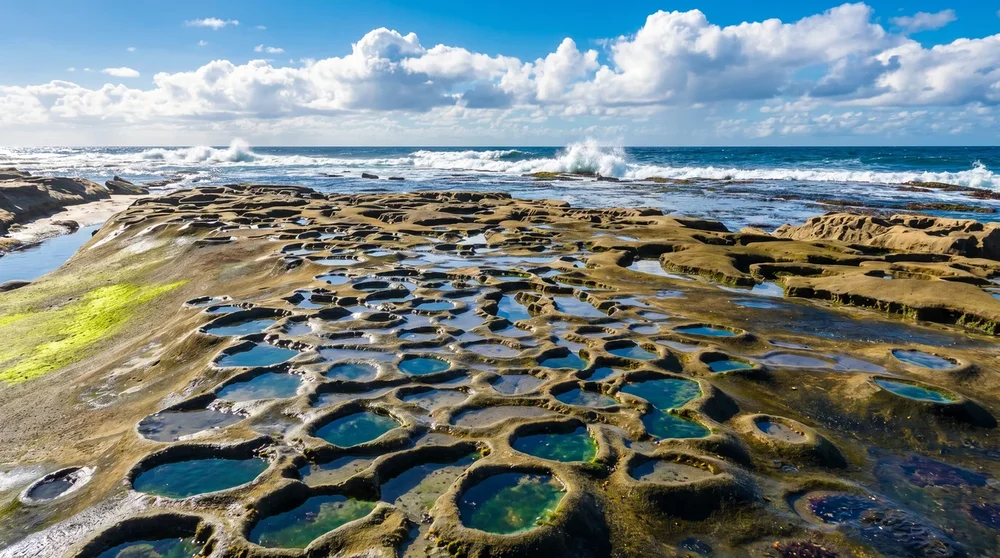
Dike Rock (North of Scripps Pier)
A naturalist favorite, this area features a blend of sandy habitats and large rock formations, and it is generally less crowded than the main cove. Walk south along La Jolla Shores beach from the main parking lot at the end of Calle Frescota.
- Accessibility: Moderate. The walk along the sand is easy, but the pools themselves require climbing over boulders.
- Parking: Use the La Jolla Shores main lot (free, fills early on weekends) or street parking on El Paseo Grande near Caroline's Seaside Cafe, then take the stairs down to the beach.
- Kid-Friendly: High. Sandy patches between rocks give smaller children room to explore without danger.
Shell Beach and La Jolla Cove
The flat rocky shelf just south of La Jolla Cove offers crystal-clear water and strong wave action against the sandstone. Access is via concrete stairs off Coast Boulevard.
- Accessibility: Easy to reach, but the rocks are very uneven once you are on them.
- Parking: Very difficult. Street parking along Coast Boulevard (La Jolla, CA 92037) is free but capped at two hours and fills fast. A paid lot is available at the La Jolla Financial Building on Prospect Street. Arrive before 9 a.m. on weekends.
- Kid-Friendly: Medium. The pools are excellent, but sections near the cove are frequently closed to protect harbor seals.
South Casa Beach (Children's Pool Area)
Located at 850 Coast Blvd, La Jolla, CA 92037, this is the easiest entry point for families. The sea wall creates calmer conditions. The beach is often shared with a colony of harbor seals, especially from December through May, and roped-off areas protect pupping zones during that period.
- Accessibility: Easy. Stairs and a short ramp provide access.
- Parking: Same Coast Boulevard street parking as La Jolla Cove.
- Kid-Friendly: High, though children must stay clear of the seal areas.
False Point (Bird Rock Neighborhood)
At the intersection of Sea Ridge Drive and Linda Way, this is a more rugged experience away from the main tourist area.
- Accessibility: Hard. Loose rocks throughout.
- Parking: Low difficulty. Residential street parking is usually available.
- Kid-Friendly: Low. The loose, slippery terrain makes this unsuitable for young children.
Marine Life: What to Expect in the Intertidal Zone
The biodiversity hidden beneath the sea grass is remarkable. Many creatures camouflage against the sandstone, so move slowly and look carefully. Gently shifting floating sea grass often reveals the best finds.
- Sea Anemones: Ubiquitous throughout the pools. They appear as pale green flowers when submerged, but curl into brown lumps when exposed to air.
- Hermit Crabs: Always active in the shallow basins, wearing turban snail shells as they move.
- Shore Crabs and Limpets: Found clinging to nearly every rock surface at the waterline.
- Two-Spot Octopuses: A rare find, but they do live here. They squeeze into tiny crevices or empty shells and can change color in seconds.
- Sea Hares: These giant sea slugs can reach up to a foot long. Their color shifts based on the algae they consume.
- Sea Stars: Less common than they once were due to sea star wasting disease, but still visible in deeper pools during strong minus tides.
For a closer look without touching, scoop a small amount of seawater into a clear container, observe the creature, then return it exactly where you found it.
If you enjoy exploring California's coastal natural areas, Glass Beach in Fort Bragg is another distinctive shoreline worth visiting, and Queen's Bath on Kauai offers a similar tidal pool experience with its own set of safety considerations.
Essential Gear for Slippery Rocks
Footwear matters more here than almost anywhere else. Rocks covered in dark green or black algae are as slippery as ice. Pack the following:
- Closed-toe water shoes or sneakers with heavy tread - no flip-flops or sandals
- Sun protection - the rocky shelf offers no shade and the reflection off the water intensifies UV exposure
- A clear plastic container - for safe close-up observation without touching
- Old clothes - sea spray and algae stains are inevitable
Always watch the ocean while on the rocks. Never turn your back on the waves. Surge events at La Jolla can push water over rocks that appear to be well above the tide line, particularly at the southern spots near South Casa Beach.
Conservation Rules in the Underwater Park Ecological Reserve
The coastline between La Jolla Cove and La Jolla Shores falls within a protected ecological reserve. The rules are strict and actively enforced by California Department of Fish and Wildlife officers:
- Do not remove anything - shells, rocks, sea glass, or any living creature. Even empty shells serve as housing for hermit crabs.
- Step on bare rock only. If a surface looks textured, fuzzy, or colorful, it is probably alive. Trampling is one of the most damaging visitor behaviors in tidal zones.
- Do not touch or pick up marine life. Handling transfers oils and bacteria that harm sensitive creatures.
- Violations of the Marine Life Protection Act carry fines starting at $5,000 and can include jail time. During recent King Tide events, officers issued over two dozen citations in a single day.
Dogs are generally not permitted on San Diego beaches between November 1 and March 31 from 9 a.m. to 4 p.m. Even outside those hours, keep dogs away from the pools entirely to protect the marine life and the animals themselves from the jagged terrain.