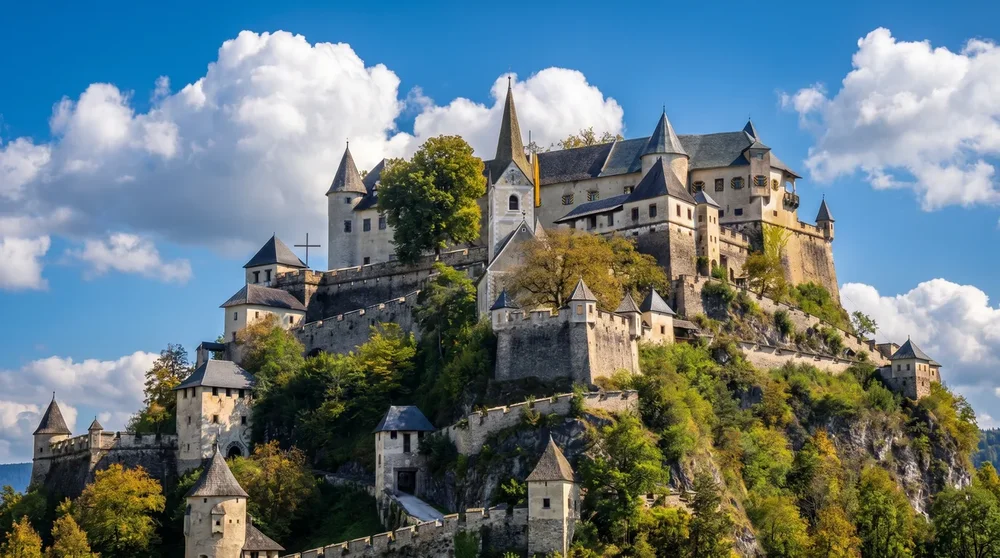
Hochosterwitz Castle sits on a 160-meter-high dolomite rock rising sharply from the flat Carinthian plain near Launsdorf, making it visible from miles before you even reach the parking lot. Paying the full adult ticket only to find most interior rooms locked is a frustration many visitors share. The real value of this fortress is not inside any room. It runs along the steep, winding path that has kept invaders out for centuries.
- Entry: €18 adult, from €8 discounted (children, students, groups)
- Funicular add-on: €10 return trip
- Parking: Free at the base
- Last admission: 90 minutes before closing
- Season: Closed in winter, reopens April 1
- Kärnten Card holders: free entry (lift excluded)
How to Get to Hochosterwitz Castle
Driving is by far the most practical option. The castle sits in Launsdorf, roughly 30 minutes from Klagenfurt and about 10 kilometers from Sankt Veit an der Glan. From the highway, the rock outcrop is unmistakable: you will see it long before you turn off.
The free parking lot at the base fills up fast on summer weekends. Arriving before 10:00 AM gives you a reliable spot. By midday in July and August, the lot is typically full and latecomers park along the road.
Public transport is possible but inconvenient. A regional train connects to Sankt Veit an der Glan, from where a taxi or local bus covers the remaining 10 kilometers. There is no direct rail connection to Launsdorf itself.
Tickets and Opening Hours
The standard adult entry costs €18 for the 2026 season, granting access to the walking path, the 14 gates, and the inner courtyard. Discounted tickets start from €8 for children, students, and groups. If you carry the Kärnten Card, entry is free, though the funicular requires a separate €10 ticket regardless.
Opening hours vary by season, and the schedule is more restrictive than many visitors expect:
| Period | Open | Days |
|---|---|---|
| April 1–30 | 10:00–17:00 | Tue–Sun (+ Easter Mon) |
| May 1–30 | 10:00–17:00 | Daily |
| May 31–Aug 31 | 09:00–18:00 | Daily |
| September | 10:00–17:00 | Tue–Sun (Mon closed) |
| Oct 1–Nov 2 | 10:00–17:00 | Wed–Sun |
Last admission is 90 minutes before closing. If you arrive at 15:30, you will be turned away at the gate. The castle closes entirely for winter from early November.
One practical note: information panels along the path and inside the museum are predominantly in German. English explanations are minimal. Download the English section of the official website before arriving if language context matters to you.
The 14 Historic Gates: Walk or Take the Funicular?
The defensive architecture of Hochosterwitz is built entirely around its access road. Reaching the top means passing through 14 fortified gates, each with a distinct trap mechanism designed to halt, expose, or confuse medieval attackers. Walking this path is the core experience, not the museum at the top.
The ascent covers roughly 620 meters and takes 20 to 30 minutes at a steady pace. The path is steep in sections and covered in loose pebbles. Wear proper sports shoes: sandals or flat-soled shoes make the descent genuinely slippery. Rest benches appear regularly along the route, which helps considerably in summer heat.
The July and August midday sun turns the south-facing rock face into a furnace. Start before 09:30 or after 16:00 in peak summer to avoid both the heat and the crowds.
The Fürst-Max-Bahn Funicular
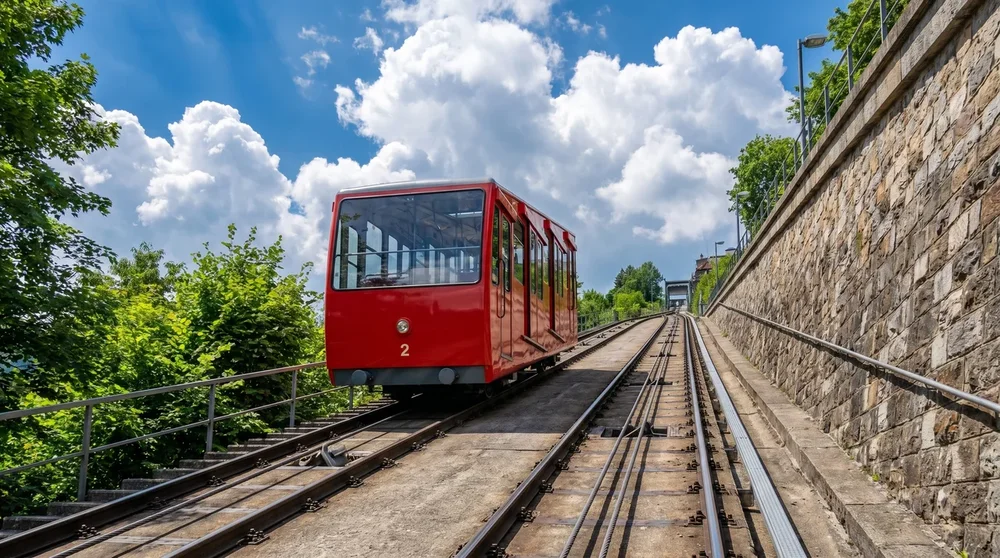
The funicular, installed in 1993, covers 105 meters of vertical rise in 95 seconds inside a glass cabin bolted to the rock face. Adding it to your ticket costs €10. It is an efficient solution for visitors with mobility limitations, but taking it up means bypassing all 14 gates entirely.
A practical middle ground: ride the lift up and walk down. The descent is easier on effort, and you photograph each gate in detail without the cardio exertion of the climb. Gates look different from below and above, and the downhill direction often reveals architectural details the upward rush misses.
Inside the Castle: Armory, Museum and Dining
Set expectations before entering the final gate. Hochosterwitz is not a furnished palace. It is a military fortress that remained in defensive use for centuries. The Khevenhüller family, who have owned the castle since 1571, keeps most of the private residential rooms closed to the public.
What you can access: a small museum tracing Khevenhüller family history, an armory with a substantial collection of medieval weapons and armor, and the inner courtyard. Occasionally a temporary art exhibition runs in one of the basement spaces.
The Burgschenke restaurant in the inner courtyard is genuinely good for what it is. Traditional Carinthian garlic soup and cold local drinks while looking out over the valley is a reasonable way to recover from the climb. Prices are fair given the location.
Is Hochosterwitz Castle Worth It?
The answer depends entirely on what you expect. Visitors who arrive hoping for furnished historical interiors (rooms, period furniture, tapestries) typically feel the €18 ticket is overpriced. Visitors who treat the fortress as an outdoor architectural trail through medieval defensive engineering consistently rate it among the best castles in Austria.
For context on how differently a European castle can feel when it prioritizes comfort over defense: the Palace of the Grand Dukes of Lithuania in Vilnius shows the opposite end of that spectrum: interior rooms, period reconstructions, and the political ambitions of a ruling dynasty on full display. Hochosterwitz is its antithesis: raw, outdoor, and military.
Holding the Kärnten Card makes the value question easy: entry is free, and the lift is the only additional cost. Without it, the ticket is worth it if the 14-gate walk is your main purpose. Budget at least 1.5 to 2 hours for the full visit including the museum.
Practical Rules: Drones, Pets, and Accessibility
The management enforces a strict no-drone policy. Flying any unmanned aerial vehicle over or around the castle grounds is prohibited and actively monitored. This applies regardless of drone size or intended use.
Dogs are allowed on the walking path. The steep incline and sharp stones can be hard on small breeds. Carry water for your animals, as no refreshment stops exist until the courtyard at the very top.
The funicular provides the only accessible route for visitors with mobility limitations. The walking path itself involves uneven stone surfaces throughout and is not wheelchair accessible.