You are standing at the birthplace of money. Seriously. Before the Lydians stamped the first electrum coins right here in the shadow of Mount Tmolus, trade was just a messy business of barter.
But Sardis is not just about gold or the legendary wealth of King Croesus. It is a place where a massive Jewish synagogue shares a wall with a Roman gymnasium and where one of the Seven Churches of Revelation sits quietly in the shadow of a pagan temple.
While thousands of tourists flock to Ephesus every day, Sardis remains a quieter, more mysterious, and frankly, a more golden experience. If you are planning your trip to Western Turkey in 2026, here is everything you need to know to explore this double-site ancient wonder without missing the hidden details.
Why Sardis is Unlike Any Other Ancient City?
Most ancient cities you visit in Turkey offer a standard layout: a theater, an agora, and a few columns. Sardis breaks this mold completely. Here you witness a unique clash of civilizations. You see the sheer power of Rome in the restored Marble Court, the deep roots of the Jewish diaspora in the Synagogue, and the early struggles of Christianity in the small brick chapels.
The energy here is different. It feels heavy with history but light on crowds. You are walking through the capital of the Lydian Empire, the very place where the phrase As rich as Croesus was born. Unlike the single-route flow of Ephesus, Sardis demands a bit more attention because it is physically divided into two separate archaeological zones.
Practical Information Before You Go
Before we dive into the ruins, let's sort out the logistics. Many visitors make the mistake of seeing only the Gymnasium and leaving, not realizing they missed half the city.
Location & How to Get There
Sardis sits in the modern village of Sart, just outside the town of Salihli in Manisa province. It is an easy 1-hour and 15-minute drive from Izmir. If you are driving from Izmir, you follow the Ankara highway east. The road is excellent and dual-carriageway the whole way.
The Two-Site Layout
This is the most critical tip I can give you. The ancient city is split into two parts:
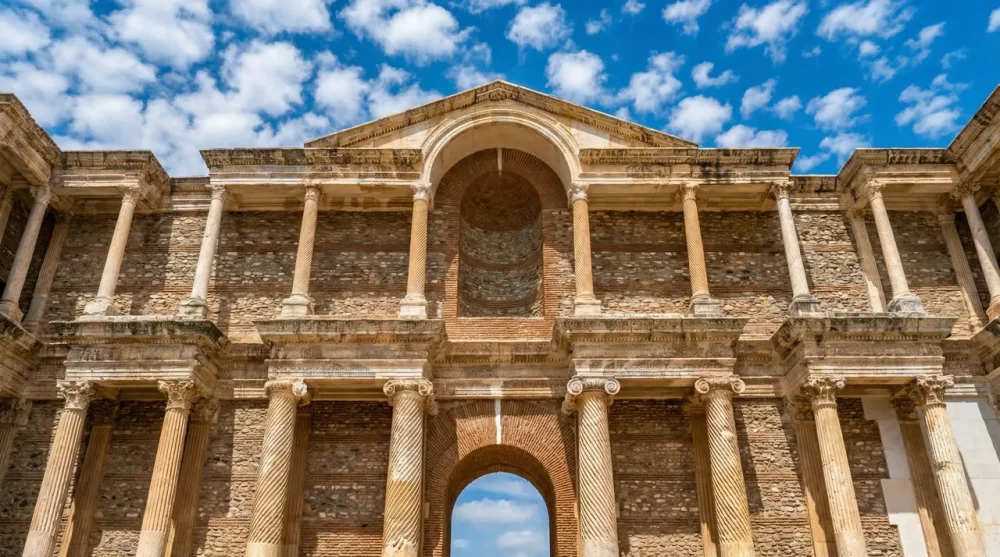
- The Gymnasium & Synagogue Complex: This is the main site right next to the highway. You park here, buy your ticket, and see the famous two-story facade.
- The Temple of Artemis: This is about 1 kilometer south of the Gymnasium. You can walk it, but I recommend driving. You keep your ticket, get back in your car, drive up the signposted road, and park at the second entrance.
Entrance Fee & Visiting Hours
Accessing both sites is quite affordable compared to other major ruins.
- Entrance Fee: 25 Euro
- Museum Pass Turkey: Valid
- Opening Hours: 08:00 - 19:00
Exploring the Gymnasium Complex (The Main Site)
When you first enter the main gate, the sheer scale of the restoration greets you. This area was the hub of social and physical life in the Roman period.

The Marble Court (Imperial Cult Hall)
This is the image you see on all the postcards. The Marble Court is the restored facade of the bath-gymnasium complex. It is not just a wall; it is a masterpiece of puzzle-solving by archaeologists. The intricate columns and the two-story structure give you a real sense of how imposing Roman architecture actually was. Unlike many ruins where you have to imagine the height, here you feel it.
The Synagogue
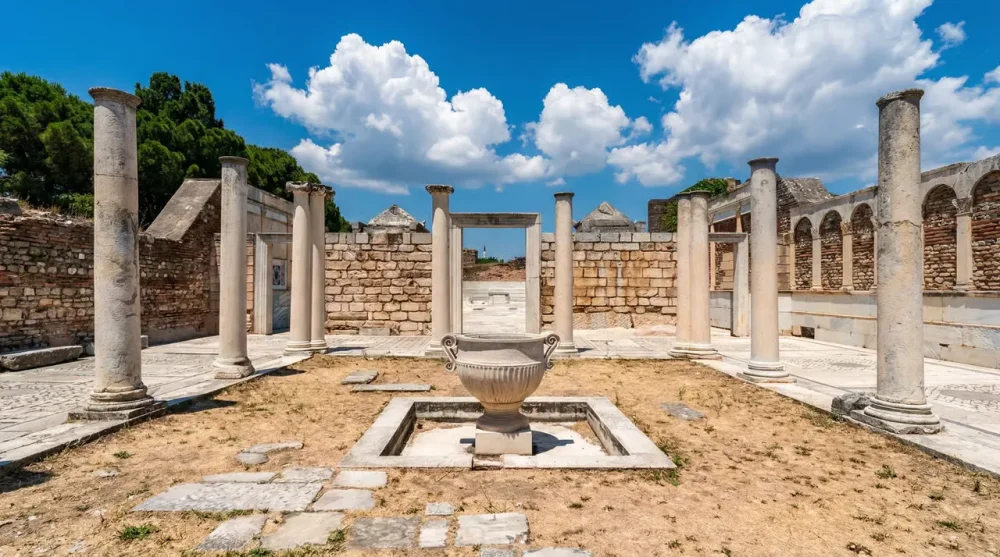
Just to the left of the Gymnasium, you enter the Synagogue. This is a game-changer for history books. Before this discovery, historians thought Jewish communities in the diaspora were small and hidden. But here we have a massive, monumental synagogue accommodating a thousand people, located right in the center of public life. Look down at the floor. The mosaic patterns are still vibrant.
The Byzantine Shops
As you walk along the southern wall of the Synagogue, you pass a row of Byzantine shops. These were once dye shops, hardware stores, and paint sellers. Archaeologists even found a Christian shop marked with crosses and a Jewish shop marked with menorahs operating side by side. It paints a picture of a tolerant, bustling commercial street.
The Temple of Artemis (The Second Site)
After you finish at the Gymnasium, hop in your car and head up the road to the Temple of Artemis. The vibe here changes instantly. You leave the Roman pomp behind and enter a quiet, mystical Lydian landscape.
Columns That Touch the Sky
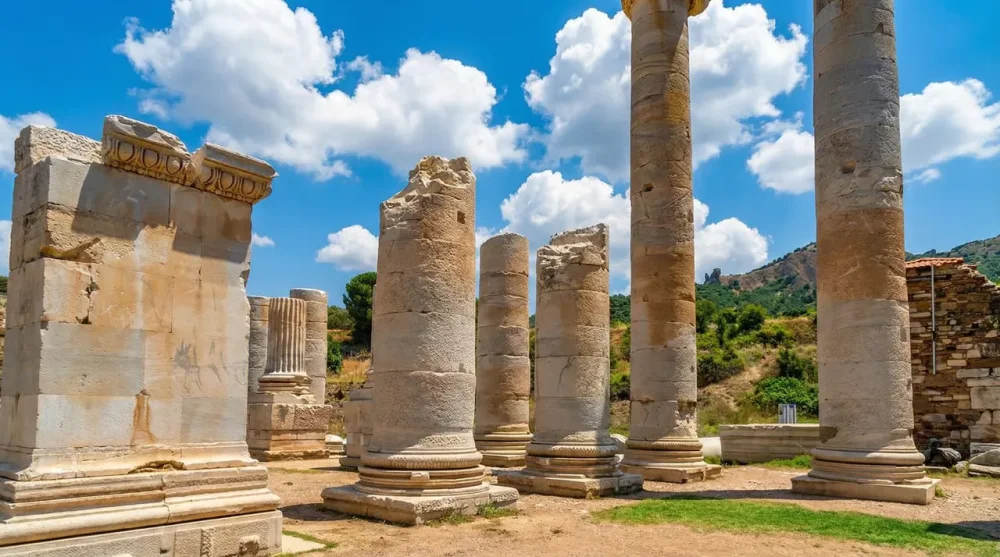
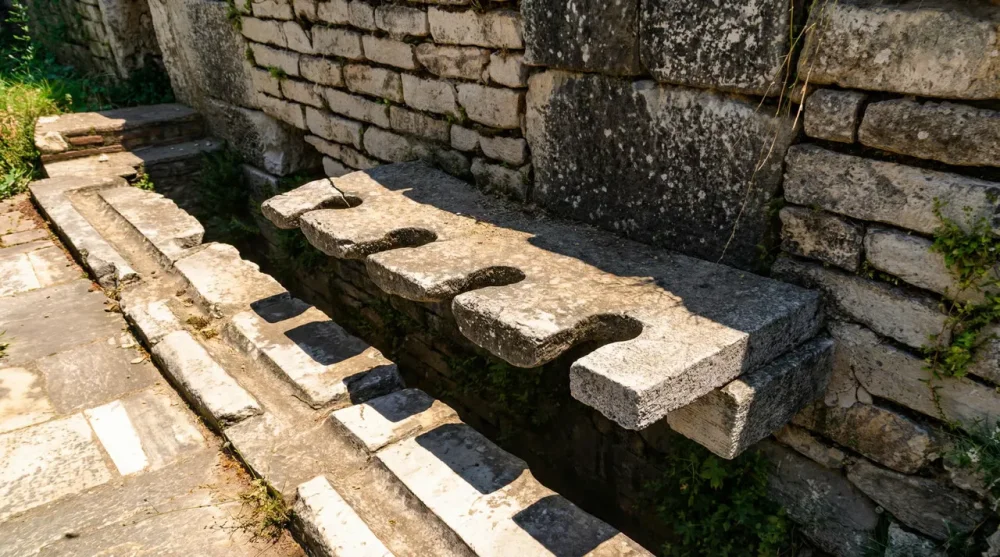
The Temple of Artemis at Sardis is one of the largest Ionic temples in the world. The columns here are staggering. Two of them stand complete, and their height makes you feel incredibly small. Notice the intricate carvings on the bases; some were never finished, giving us a snapshot of construction halted by time or turmoil.
The Church M
Right behind the colossal pagan temple, you will spot a small, humble brick building. This is Church M. It dates back to the 4th century and represents the physical takeover of Christianity. It is built practically touching the pagan temple, a bold statement of the new faith eclipsing the old gods.
Sardis in Biblical History
For those interested in faith history, Sardis is one of the Seven Churches of Revelation. In the Book of Revelation (3:1-6), the author John writes to the church in Sardis: You have a name that you are alive, but you are dead.
This harsh rebuke likely refers to the city's history of complacency. Sardis was considered impregnable due to its location on a steep hill (the Acropolis), yet it was captured twice by enemies who simply climbed the cliffs while the guards slept. The biblical message warns the early Christians here not to fall into the same spiritual laziness.
The Legend of Gold: King Croesus & River Pactolus
You cannot leave Sardis without looking at the Pactolus River (now the Sart Çayı) that flows nearby. Myth says King Midas washed his golden touch off in this river, turning the sands to gold.
In reality, the river carried alluvial gold dust. The Lydians were the first in history to figure out how to separate gold from silver using salt and heat, allowing them to mint the world's first standard currency. This innovation changed human history forever, moving us from barter to a complex economy.
What to See Nearby?
If you have time after exploring the ruins, the area offers a few more gems:
- Bintepe Tumuli: On your way to or from Sardis, look at the horizon to the north. You will see dozens of small hills. These are not natural; they are the Pyramids of Turkey, the burial mounds of Lydian kings.
- Salihli: A great spot to stop for lunch. The local Odun Köfte (wood-fired meatballs) is famous in the region.
Sardis offers a deep, multi-layered experience that connects the dots between mythology, economy, and theology. It is a place where you can stand in a Roman bath, a Jewish synagogue, and a Christian church all within an hour.