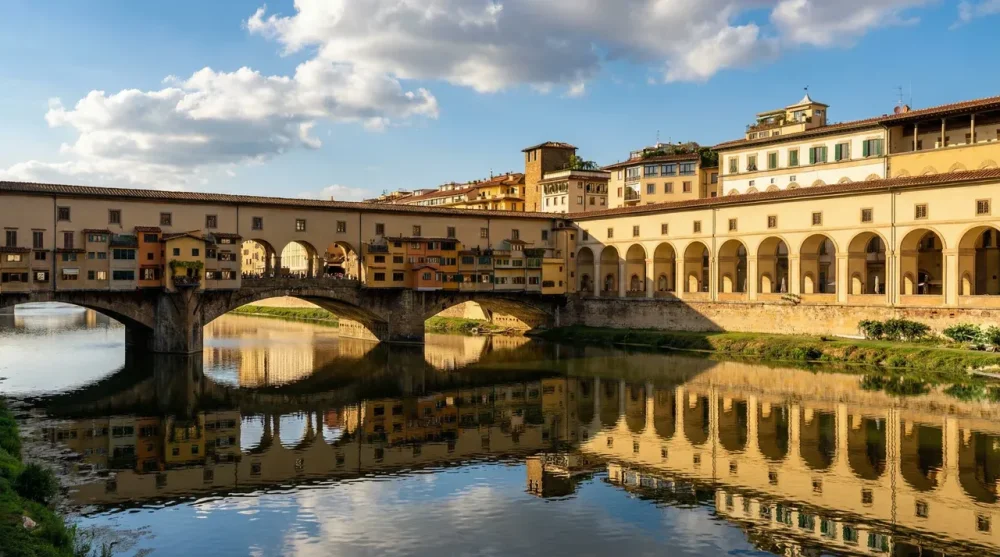
Stepping onto Ponte Vecchio feels less like crossing a river and more like walking through a suspended medieval neighborhood. Lined with glittering jewelry boutiques, the bridge carries the quiet elegance of centuries past.
You walk across timeless stone arches, yet you find icons of contemporary prestige, like a modern Rolex boutique, right next to you. The contrast striking, almost surreal.
- Built: 1345
- Open: 24/7 (Shops usually open 10:00 AM to 7:00 PM)
- Entry Fee: Free
- Location: Spans the Arno River, connecting the historical center to Oltrarno.
A Brief History of Florence's Oldest Bridge
Designed by Taddeo Gaddi and finished in 1345, this stone structure replaced an earlier wooden bridge destroyed by floods. For centuries, the bridge served as the city's gut. Butchers, tanners, and fishmongers occupied the tiny houses clinging to the edges, tipping their scraps and blood directly into the Arno River below.
By the late 1500s, Duke Ferdinand I had enough of the unbearable stench. He expelled the noisy and dirty trades completely. He replaced them with goldsmiths and jewelers, who could pay higher rents and offer a more refined atmosphere fitting for the city center. That single decision shapes everything you see in those windows today.
Surviving World War II: The Only Bridge Left Standing
In 1944, retreating German forces blew up every single bridge in Florence to slow down the Allied advance. Ponte Vecchio was the sole survivor. Spared not by chance, but by a deliberate direct order, it remained intact while the buildings at its immediate ends turned to rubble. The bridge later took another massive beating during the devastating flood of 1966, yet its sturdy medieval engineering held firm.
The Secret Above: What is the Vasari Corridor?
As you shuffle past the crowded shop windows, look up. You notice a continuous row of small, barred windows running right above the store roofs.
This is the Vasari Corridor. Built in 1565 by Giorgio Vasari, this private elevated passageway allowed the ruling Medici family to move safely and unseen between their political headquarters at Palazzo Vecchio and their private residence at Palazzo Pitti. They wanted to travel without mingling with the common public below. Knowing that a grand Duke once walked right above your head adds a fascinating layer to your crossing.
Shopping on Ponte Vecchio: Gold, Leather, and Souvenirs
Today, local laws restrict the bridge shops exclusively to goldsmiths, jewelers, and watchmakers. The display cases, adorned with gold and precious stones, glitter brilliantly even in the deep shadows of the overhanging roofs.
Are the items expensive? Yes. The prices carry a heavy tourist premium. If you plan to buy fine Italian gold or a luxury timepiece, do your research beforehand. Some visitors specifically recommend exploring the smaller, numbered stalls for unique local craftsmanship rather than just the globally recognized brand names. Even if you do not buy anything, stopping by these displays is a must. The external architecture of the shops still closely mirrors their Renaissance-era designs.
Best Vantage Points for Ponte Vecchio Photography
Standing directly on the bridge gives you zero perspective of its iconic arches and the chaotic, uneven houses hanging over the water. To get that postcard-perfect shot, you need to step away.
Walk down the riverbank to Ponte Santa Trinita.
This neighboring bridge offers the absolute best panoramic view of Ponte Vecchio. From here, you truly appreciate the gothic overcrowding of the buildings and the three shallow stone arches stepping across the water. Alternatively, the large windows in the nearby Uffizi Gallery provide a magnificent elevated angle, allowing you to capture the bridge with the Oltrarno district rolling in the background.
Practical Tips for Your Visit
Best Time to Visit to Avoid Crowds
During the middle of the day, crossing the bridge becomes a slow, shoulder-to-shoulder shuffle. Tour groups fill every gap, and the experience easily turns overwhelming.
For a peaceful walk, arrive before 8:00 AM. The morning air cool, the historic street completely empty.
If you want the best visual experience, go just before sunset. The late afternoon light hits the river, making the stone walls glow with warm orange hues. Stick around until nightfall. The atmosphere at night completely different. The jewelry shops close up like heavy wooden treasure chests, street musicians start playing acoustic sets, and the city lights reflect beautifully on the dark Arno River.
The Truth About Love Padlocks (And Fines)
You might spot a few random padlocks attached to the fences around the central viewing gaps. Do not attach one yourself.
The city strictly prohibits this practice because the immense weight of thousands of metal locks causes severe structural damage to the historic stonework. If local police catch you clamping a love lock to the bridge, they will hand you an immediate 160 Euro fine. Save your money for a great Florentine dinner instead.
How to Get to Ponte Vecchio
Finding the bridge requires almost no navigation. Located right in the pedestrian-heavy historic center, it is a straight 10-minute walk south from the Duomo. Follow Via Roma straight down into Via Por Santa Maria, and the road naturally funnels you right onto the bridge. There is no vehicular traffic allowed, making it incredibly safe for walking.
What to See Nearby
Your journey does not end once you cross the Arno. On the Oltrarno side, you immediately enter a more relaxed, artisan neighborhood. Head straight up the street to explore the massive Palazzo Pitti and the expansive Boboli Gardens behind it.
Before you start climbing the hills, grab a scoop of local gelato. The small streets immediately branching off either end of the bridge hide some fantastic, tucked-away gelaterias. Eat your ice cream by the riverbank, look back at the chaotic cluster of medieval shops, and soak in the true soul of Florence.